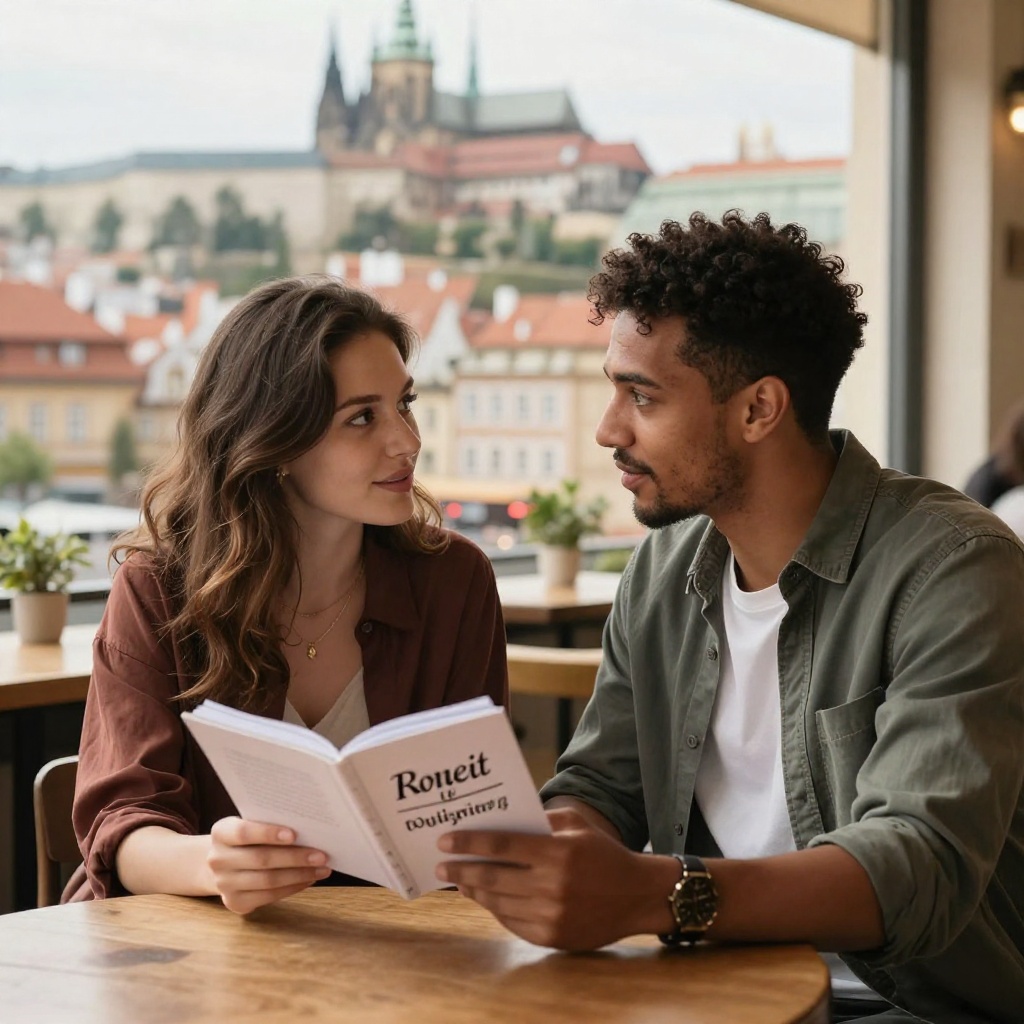
50 Czech Compliments for Your Partner
Master 'Jsi krásná/ý' and 50+ Czech compliments. Pronunciation guide included.
Czech people may seem reserved at first, but they have a wonderfully rich vocabulary for expressing admiration. Learning to compliment your Czech partner in their native language will truly warm their heart.
The Most Beautiful Compliment
Phrase to Learn
Jsi nádherná
You are gorgeous (to a woman)
[ Y-SEE NAD-her-na ]
One of the most beautiful compliments in Czech. 'Nádherná' conveys exceptional, breathtaking beauty.
In Czech culture, sincere compliments carry real meaning. They're not given lightly, making them all the more special when received.
Complimenting Appearance
Czech adjectives change their endings based on the gender of the person being described, which makes praising someone's appearance a great lesson in basic grammar. When you want to tell your partner they look nice, the choice of words often shifts depending on whether you are highlighting feminine elegance or masculine charm. This section focuses on the overall aesthetic, providing phrases that work for both casual daily sightings and special occasions.
The following lists are divided into categories for women and for men to ensure your grammar remains accurate. While some expressions are interchangeable, many Czech speakers prefer specific descriptors like 'krásná' for a woman and 'pohledný' for a man. Understanding these distinctions helps you sound more like a native speaker while expressing your admiration.
Pronunciation: vi-pah-daat
"Dneska vypadáš skvěle."
For Women
Pronunciation: Y-SEE KRAHS-NAH
"Jsi dnes moc krásná!"
Pronunciation: Y-SEE NAD-her-na
"Vypadáš nádherně!"
Pronunciation: Y-SEE o-KOW-zlu-yee-tsee
"Jsi tak okouzlující!"
Pronunciation: Y-SEE POO-vab-na
"Jsi velmi půvabná."
Pronunciation: Y-SEE OO-zhas-na
"Jsi prostě úžasná!"
For Men
Pronunciation: Y-SEE HEZ-kee
"Jsi velmi hezký!"
Pronunciation: Y-SEE przhee-TAZH-li-vee
"Jsi velmi přitažlivý muž."
Pronunciation: Y-SEE MOOZH-nee
"Jsi tak mužný!"
Pronunciation: Y-SEE e-le-GANT-nee
"Dnes vypadáš elegantně!"
Gender Agreement
Czech adjectives change based on gender. Words ending in "-ý" are masculine, while "-á" endings are feminine. Using the correct form shows respect for your partner and the language!
Complimenting Specific Features
Focusing on a specific detail can make a compliment feel much more personal and sincere than a general statement. In Czech, describing physical features typically involves the verb 'mít' (to have) followed by the feature in the accusative case. This section provides the vocabulary needed to pinpoint exactly what you find attractive, whether it is the color of their eyes or the sound of their laughter.
We have organized these phrases into three subsections: eyes, smile, and voice. Each category includes common adjectives used to describe these features, such as 'hluboké' (deep) for eyes or 'nakažlivý' (contagious) for a smile. Learning these specific pairings allows you to move beyond basic sentences and offer more nuanced praise.
Eyes
Pronunciation: MAHSH KRAHS-NEH O-chi
"Máš tak krásné oči!"
Pronunciation: TVO-ye O-chi Y-SOH-OO ya-ko HVYEZ-di
"Ach, tvoje oči jsou jako hvězdy."
Pronunciation: TO-peem se f tveekh O-cheekh
"Topím se v tvých očích, lásko."
Smile
Pronunciation: MAHSH KRAHS-NEE OO-smyev
"Tvůj úsměv mi rozjasní den."
Pronunciation: Y-SEE KRAHS-NAH, kdish se us-MEE-vash
"Jsi krásná, když se usmíváš, zlato."
Voice
Pronunciation: MAHSH KRAHS-NEE hlas
"Rád/a poslouchám tvůj hlas."
Personality Compliments
Long-term connections are built on more than just physical attraction, and the Czech language has a rich vocabulary for describing a person's character. Czechs often value traits like 'dobrota' (kindness) and 'smysl pro humor' (sense of humor), making these compliments particularly meaningful in a relationship. This section helps you articulate why you value your partner's mind and soul.
The subsections cover kindness and character, intelligence and talent, and humor. You will find that many of these phrases use the verb 'být' (to be), requiring you to match the adjective to your partner's gender. Highlighting someone's wit or their sharp intellect shows that you are paying attention to the qualities that truly define them.
Kindness and Character
Pronunciation: Y-SEE HOD-nee / HOD-na
"Jsi tak hodná ke všem."
Pronunciation: Y-SEE sta-ROST-li-vee / sta-ROST-li-va
"Jsi tak starostlivý partner."
Pronunciation: Y-SEE o-HLED-up-lnee / o-HLED-up-lna
"Jsi vždy tak ohleduplný."
Pronunciation: Mash ZLA-te SERD-tse
"Děkuji, máš zlaté srdce."
Intelligence and Talent
Pronunciation: Y-SEE KHIT-ree / KHIT-ra
"Jsi tak chytrá!"
Pronunciation: Y-SEE ta-len-TO-va-nee / ta-len-TO-va-na
"Jsi neuvěřitelně talentovaný!"
Pronunciation: Y-SEE ge-ni-AL-nee
"Ten nápad je geniální, jako ty!"
Humor and Fun
Pronunciation: Y-SEE VTIP-nee / VTIP-na
"Jsi tak vtipný!"
Pronunciation: S TE-bow ye LEG-ra-tse
"S tebou je vždycky legrace!"
Czech Directness
Czechs value sincerity over flattery. A genuine, heartfelt compliment means more than excessive praise. When you compliment someone, mean it - Czechs can easily spot insincerity!
Romantic Compliments
Pronunciation: Y-SEE MO-ye SHTYES-tee
"Jsi celé moje štěstí."
Pronunciation: DYEL-ash mnye SHTYAST-neem / SHTYAST-now
"Každý den mě děláš šťastným."
Pronunciation: Y-SEE to NEY-lep-shee, tso mnye POT-ka-lo
"Jsi to nejlepší, co mě potkalo, miluji tě."
Pronunciation: Sem na TE-be HER-dee / HER-da
"Jsem na tebe tak hrdá!"
Pronunciation: S TE-bow se TSEE-teem VEE-yi-mech-nee / VEE-yi-mech-na
"S tebou se cítím vždy výjimečný."
Complimenting Actions and Efforts
Pronunciation: VA-rzheesh BOZH-ski
"Tohle jídlo je božské!"
Pronunciation: VSHEKH-no DYEL-ash per-FEKT-nye
"Všechno, co děláš, děláš perfektně."
Pronunciation: LEE-bee se mi, yak to DYEL-ash
"Líbí se mi, jak to děláš, jsi šikovný/á."
Poetic Comparisons
Czechs appreciate poetic expressions, but the best ones still feel grounded and specific. Romantic comparisons should sound warm rather than overblown, especially early in a relationship.
Pronunciation: Y-SEE KRAHS-NAH ya-ko ROO-zhe
Romantic and flattering; best for a partner who enjoys classic, soft imagery.
Pronunciation: ZA-rzheesh ya-ko SLUN-tse
Warm and romantic without being too intense; a strong everyday poetic compliment.
Pronunciation: Y-SEE ya-ko AN-dyel
More idealized and slightly more intense; use it when the relationship already feels close and affectionate.
Pronunciation: Y-SEE ya-ko HVYEZ-dah na NOHCH-nee oh-blo-ze
Poetic and romantic; it works best when you want to sound thoughtful rather than dramatic.
Pronunciation: Y-SEE mooy KLEET
Deeply romantic and intimate; use it when you want to express emotional safety, not just attraction.
Flowers in Czech Culture
Like many Central European countries, Czechs often give flowers with compliments. Remember: always give an odd number of flowers - even numbers are reserved for funerals.
Responding to Compliments
When your partner compliments you, here's how to respond:
| Czech | Pronunciation | English |
|---|---|---|
| Děkuji | DYE-ku-yi | Thank you |
| Ty taky | Ti TA-ki | You too |
| Lichotíš mi | LI-kho-teesh mi | You flatter me |
| Opravdu? | OP-rav-du | Really? |
| Jsi tak milý/milá | See tak MI-lee / MI-la | You're so sweet |
| To je milé slyšet | To ye MI-le SLI-shet | That's nice to hear |
Daily Compliments to Use
Make it a habit to compliment your partner daily:
| Situation | Czech | English |
|---|---|---|
| Morning | Vypadáš skvěle | You look great |
| After cooking | Moc dobré! | Very delicious! |
| Getting dressed | To ti sluší | It suits you |
| Working hard | Jsi skvělý/skvělá | You're great |
| Being supportive | Děkuji, že jsi | Thanks for being you |
| Before bed | Mám štěstí, že tě mám | I'm lucky to have you |
Quick Reference: Essential Compliments
When you are in the middle of a conversation, you may not always have time to construct complex sentences. This quick reference guide gives you the compliments most likely to be useful in real life, grouped by who they work best for. Use the "for her" and "for him" lists when you want clear gender agreement, and use the universal phrases when you want something that sounds natural with less grammar pressure.
As a rule of thumb, the most casual compliments are short adjectives like krásná or hezký; the most romantic ones are phrases like Jsi moje štěstí; and the most poetic ones sound vivid but should still feel sincere. If you are unsure, start with a simple, direct line and then build up to more expressive language.
Pronunciation: mi-lee
"Jsi na mě tak milý." Used for a warm, everyday compliment; in the feminine form, say milá.
For Her
| Czech | English |
|---|---|
| Jsi krásná | You're beautiful |
| Jsi nádherná | You're gorgeous |
| Jsi okouzlující | You're charming |
| Jsi chytrá | You're smart |
| Jsi hodná | You're kind |
For Him
| Czech | English |
|---|---|
| Jsi hezký | You're handsome |
| Jsi silný | You're strong |
| Jsi mužný | You're manly |
| Jsi chytrý | You're smart |
| Jsi hodný | You're kind |
Universal
| Czech | English |
|---|---|
| Jsi výjimečný/výjimečná | You're special |
| Jsem na tebe hrdý/hrdá | I'm proud of you |
| Jsi moje všechno | You're my everything |
| S tebou je mi dobře | I feel good with you |
| Jsi nejlepší | You're the best |
Related Articles
Ready to learn together?
Speak their language, touch their heart. Fun games, voice practice & goals made for two.
Start Learning for $0.00 →✨ Try free — no credit card needed
Frequently Asked Questions
How do you remember whether to use the masculine or feminine form of Czech compliments?
The key rule is that adjectives ending in -ý are for men and -á are for women. Practice by always learning compliments in pairs with your partner, taking turns saying both the masculine and feminine versions until the gender endings become automatic.
What is the most natural way to deliver a compliment in Czech without sounding textbook?
Czechs appreciate sincerity over flourish. Keep your tone warm and casual, and pair the compliment with a smile or touch. Starting with a simple phrase like "Víš co?" (You know what?) before the compliment makes it sound conversational rather than rehearsed.
How do Czech people typically react when a foreigner compliments them in Czech?
Most Czech speakers are pleasantly surprised and genuinely touched when a foreigner makes the effort to compliment them in their language. Expect a mix of delight and perhaps some shy deflection, as Czechs tend to be modest about receiving praise. Your effort matters more than perfect grammar.
Can I use informal Czech compliments with my partner's parents or should I use formal versions?
Always use formal versions with your partner's parents until they explicitly invite you to use informal language. In Czech, using the wrong register can come across as disrespectful. Ask your partner to help you practice the formal versions of key compliments before family visits.
How often should I compliment my Czech-speaking partner in their language?
Aim for at least one genuine Czech compliment per day, ideally at different moments like morning, after cooking, or before bed. Practicing daily with your partner or family keeps the phrases fresh in your memory and shows consistent effort rather than occasional grand gestures.