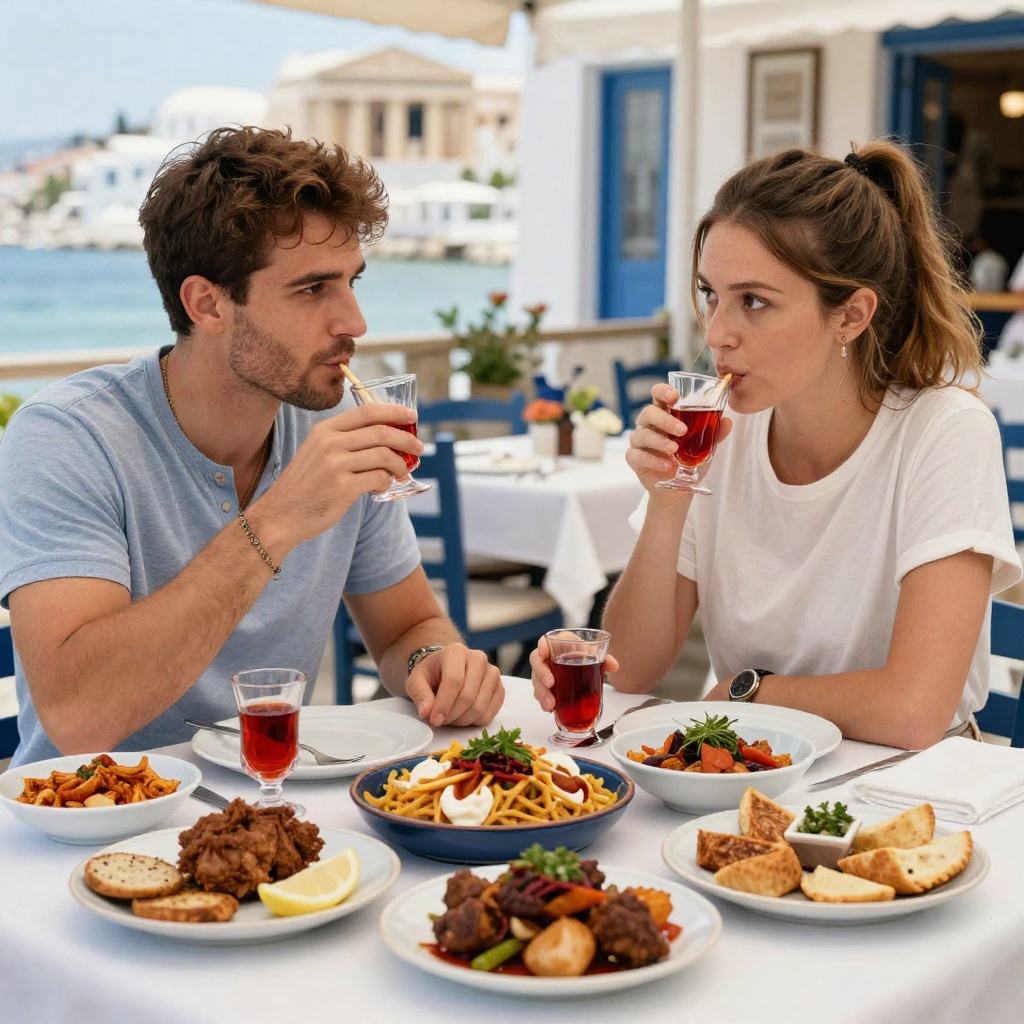
Greek Restaurant Vocabulary for Dining Out
Master essential Greek restaurant vocabulary for dining out with your partner. From ordering food to paying the bill, learn everything you need.
Greek cuisine is a celebration of fresh ingredients, bold flavors, and shared moments. Dining out with your partner in Greece is a wonderful experience, and knowing the right vocabulary will make it even more enjoyable.
Essential Opening Phrase
Phrase to Learn
Ένα τραπέζι για δύο, παρακαλώ
A table for two, please
[ E-na tra-PE-zi ya DHEE-o, pa-ra-ka-LO ]
The first phrase you'll need when entering a restaurant with your partner.
Arriving at the Restaurant
Pronunciation: E-he-te KRA-ti-si
"Έχετε κράτηση για απόψε;"
Pronunciation: E-hoo-me KRA-ti-si sto O-no-ma
"Έχουμε κράτηση στο όνομα Παπαδόπουλος."
Pronunciation: bo-ROO-me na E-hoo-me ton ka-TA-lo-go
"Μπορούμε να έχουμε τον κατάλογο, παρακαλώ;"
Greek Restaurant Etiquette
Greek hospitality is legendary! Don't be surprised if the owner comes to chat or offers complimentary drinks. Meals in Greece are meant to be leisurely - rushing is considered unusual. Enjoy the relaxed pace together!
Reading the Menu
Deciphering a Greek menu, or 'katalogos,' requires a basic understanding of how dishes are categorized in traditional tavernas and modern restaurants. Unlike some Western menus that follow a strict three-course structure, Greek dining often emphasizes a variety of plates brought to the table as they are ready. Identifying the headers on the page helps you locate specific types of food, such as seafood, grilled meats, or vegetable-based dishes, without needing to translate every individual ingredient.
The following section on ### Menu Sections breaks down the standard terminology you will encounter. You will learn to distinguish between 'Orektika' (appetizers) and 'Kyrios Piata' (main courses), as well as more specific categories like 'Tis Oras,' which refers to meats grilled to order. Recognizing these labels allows for a more efficient selection process, especially when navigating handwritten daily specials.
Pronunciation: o ka-TA-lo-ghos
"Μπορώ να έχω τον κατάλογο, παρακαλώ;"
Menu Sections
| Greek | Pronunciation | English |
|---|---|---|
| Μενού | me-NOO | Menu |
| Ορεκτικά | o-rek-ti-KA | Appetizers |
| Σαλάτες | sa-LA-tes | Salads |
| Σούπες | SOO-pes | Soups |
| Κυρίως πιάτα | ki-RI-os pi-A-ta | Main courses |
| Κρεατικά | kre-a-ti-KA | Meat dishes |
| Ψάρια/Θαλασσινά | PSA-ri-a / tha-la-si-NA | Fish/Seafood |
| Επιδόρπια | e-pi-THOR-pi-a | Desserts |
| Ποτά | po-TA | Drinks |
Pronunciation: ti mas pro-TI-ne-te
"Θέλουμε να δοκιμάσουμε κάτι καινούργιο, τι μας προτείνετε;"
Pronunciation: pi-O I-ne to spe-sia-li-TE sas
"Πριν παραγγείλουμε, θέλουμε να ρωτήσουμε, ποιο είναι το σπεσιαλιτέ σας;"
Ordering Food
Pronunciation: I-ma-ste E-ti-mi na pa-ran-GI-loo-me
"Είμαστε έτοιμοι να παραγγείλουμε, ευχαριστούμε."
Pronunciation: tha PA-ro...
"Θα πάρω μουσακά."
Pronunciation: ya ME-na...
"Για μένα, σουβλάκι, παρακαλώ."
Pronunciation: ke ya tin ko-PE-la / ton FI-lo moo
"Θα πάρω ένα σουβλάκι, και για την κοπέλα μου ένα μουσακά."
Dietary Preferences
Pronunciation: I-me hor-to-FA-gos
"Έχετε χορτοφαγικά πιάτα;"
Pronunciation: ho-RIS KRE-as, pa-ra-ka-LO
"Θα ήθελα αυτό το πιάτο, αλλά χωρίς κρέας, παρακαλώ."
Pronunciation: E-ho a-ler-YI-a se...
"Έχω αλλεργία σε ξηρούς καρπούς."
Greek Dining Traditions
Greeks love sharing food! Order several mezedes (small plates) to share, then move on to main courses. Popular dishes include moussaka, souvlaki, and fresh grilled fish. Always end with Greek coffee and maybe some baklava!
Drinks
| Greek | Pronunciation | English |
|---|---|---|
| Νερό | ne-RO | Water |
| Κρασί | kra-SI | Wine |
| Μπύρα | BI-ra | Beer |
| Τσάι | tsa-I | Tea |
| Καφές | ka-FES | Coffee |
| Χυμός | hi-MOS | Juice |
| Ούζο | OO-zo | Ouzo |
| Ρετσίνα | re-TSI-na | Retsina wine |
Pronunciation: E-na po-TI-ri KO-ki-no / lef-KO kra-SI
"Δύο ποτήρια κόκκινο κρασί, παρακαλώ."
Pronunciation: E-na boo-KA-li ne-RO, pa-ra-ka-LO
"Με ανθρακικό ή χωρίς; (Sparkling or still?)"
During the Meal
Pronunciation: ka-LI O-re-ksi
"Ο σερβιτόρος μας είπε «Καλή όρεξη!»"
Pronunciation: I-ne pen-ta-NO-sti-mo
"Το φαγητό είναι πεντανόστιμο!"
Pronunciation: bo-ROO-me na E-hoo-me LI-go pso-MI?
"Μπορούμε να έχουμε λίγο ψωμί, παρακαλώ;"
Pronunciation: a-LA-ti ke pi-PE-ri, pa-ra-ka-LO
"Μπορούμε να έχουμε αλάτι και πιπέρι, παρακαλώ;"
Describing Food
| Greek | Pronunciation | English |
|---|---|---|
| Νόστιμο | NO-sti-mo | Delicious |
| Αλμυρό | al-mi-RO | Salty |
| Γλυκό | gli-KO | Sweet |
| Πικάντικο | pi-KAN-ti-ko | Spicy |
| Ζεστό | ze-STO | Hot |
| Κρύο | KRI-o | Cold |
| Φρέσκο | FRE-sko | Fresh |
Paying the Bill
Pronunciation: ton lo-ga-ri-as-MO, pa-ra-ka-LO
"Σερβιτόρε, τον λογαριασμό, παρακαλώ."
Pronunciation: bo-RO na pli-RO-so me KAR-ta
"Μπορώ να πληρώσω με κάρτα ή μόνο με μετρητά;"
Pronunciation: tha pli-RO-soo-me ma-ZI
"Δεν χρειάζεται να χωρίσετε, θα πληρώσουμε μαζί."
Pronunciation: ho-ri-STA, pa-ra-ka-LO
"Θα πληρώσουμε χωριστά, παρακαλώ."
Tipping in Greece
Tipping in Greece is appreciated but not mandatory. Leaving 5-10% or rounding up is common. You can leave cash on the table or tell the server to keep the change by saying "κρατήστε τα ρέστα" (kra-TI-ste ta RE-sta).
Useful Table Items
| Greek | Pronunciation | English |
|---|---|---|
| Πιάτο | pi-A-to | Plate |
| Πιρούνι | pi-ROO-ni | Fork |
| Μαχαίρι | ma-HE-ri | Knife |
| Κουτάλι | koo-TA-li | Spoon |
| Ποτήρι | po-TI-ri | Glass |
| Φλιτζάνι | fli-DZA-ni | Cup |
| Χαρτοπετσέτα | har-to-pe-TSE-ta | Napkin |
| Μπουκάλι | boo-KA-li | Bottle |
Romantic Phrases for Dinner
Pronunciation: stin i-YA mas
"Σηκώστε τα ποτήρια! Στην υγειά μας!"
Pronunciation: stin a-GA-pi
"Απόψε πίνουμε στην αγάπη!"
Pronunciation: I-se pa-NE-mor-fi a-PO-pse
"Μου αρέσει πολύ το φόρεμά σου, είσαι πανέμορφη απόψε."
Pronunciation: ma-RE-si na per-NA-o HRO-no ma-ZI soo
"Σε ευχαριστώ για την όμορφη βραδιά, μ'αρέσει να περνάω χρόνο μαζί σου."
Common Problems and Solutions
Pronunciation: si-GNO-mi, af-TO then I-ne i pa-ran-ge-LI-a moo
"Συγγνώμη, νομίζω ότι αυτό δεν είναι η παραγγελία μου."
Pronunciation: af-TO I-ne po-LI KRI-o
"Συγγνώμη, αλλά αυτό είναι πολύ κρύο."
Pronunciation: poo I-ne i too-a-LE-ta
"Συγγνώμη, μπορείτε να μου πείτε πού είναι η τουαλέτα;"
Making Reservations
Pronunciation: tha I-the-la na KA-no KRA-ti-si
"Θα ήθελα να κάνω κράτηση για αύριο βράδυ."
Pronunciation: ya ti O-ra
"Για τι ώρα θέλετε την κράτηση;"
Pronunciation: ya tis ok-TO to VRA-thi
"Η κράτηση είναι για τις οκτώ το βράδυ."
Pronunciation: ya THI-o A-to-ma
"Η κράτηση είναι για δύο άτομα."
Quick Reference
Navigating a meal in Greece involves distinct linguistic stages, from the initial greeting to the final request for the check. This section serves as a functional guide to the phrases used during different phases of the dining experience. Understanding the social flow of a Greek meal ensures that you can communicate your needs clearly to the staff, whether you are looking for a table for four or need an extra carafe of house wine.
We have organized these essential phrases into four chronological categories: ### Arriving, ### Ordering, ### During Meal, and ### Paying. Each subsection provides the specific verbs and nouns required to handle interactions with the 'servitoros' (waiter) effectively. By focusing on these high-frequency expressions, you can maintain the pace of the conversation throughout your visit to the 'taverna' or 'estiatorio.'
Pronunciation: o lo-gha-rya-ZMOS
"Τον λογαριασμό, παρακαλώ."
Arriving
- Καλησπέρα - Good evening
- Τραπέζι για δύο - Table for two
- Έχουμε κράτηση - We have a reservation
Ordering
- Τον κατάλογο, παρακαλώ - Menu, please
- Θα πάρω... - I'll have...
- Τι προτείνετε; - What do you recommend?
During Meal
- Καλή όρεξη! - Enjoy your meal!
- Πεντανόστιμο! - Delicious!
- Λίγο νερό, παρακαλώ - Some water, please
Paying
- Τον λογαριασμό, παρακαλώ - The bill, please
- Με κάρτα; - By card?
- Ευχαριστούμε, ήταν υπέροχο - Thank you, it was wonderful
Mastering these essential phrases will help you navigate the vibrant Greek dining scene with confidence and ease. Whether you're enjoying a casual meal at a seaside taverna or a more formal dinner in the heart of Athens, being able to interact with the staff in their native tongue adds a layer of warmth to your experience. Greek culture places a high value on hospitality, or 'philoxenia,' and locals truly appreciate it when visitors make an effort to speak even a few words of the language.
Don’t be afraid to make mistakes as you practice these expressions. The most important part of dining out in Greece is the shared experience and the joy of the meal itself. With these phrases in your repertoire, you are well-equipped to enjoy the incredible flavors of the Mediterranean and the heartfelt service that makes Greek dining so special. Practice them before your next trip, and you'll find that a simple 'Efcharisto' goes a long way!
Related Articles
Ready to learn together?
Speak their language, touch their heart. Fun games, voice practice & goals made for two.
Start Learning for $0.00 →✨ Try free — no credit card needed
Frequently Asked Questions
What's the best way to politely get a waiter's attention in Greece?
While snapping your fingers or saying "garçon" can be considered rude, a simple "parakaló" (please) while making eye contact and a slight wave is generally appreciated. If they are far away, a more pronounced wave with an open palm, still accompanied by "parakaló", will do the trick. Couples can practice this at home by role-playing scenarios in a mock restaurant setting.
How do I specify that I have a food allergy in Greek?
The best way to communicate a food allergy is to say "Écho alergía sto..." (I am allergic to...). Then specify the food, for example, "Écho alergía sto arachídes" (I am allergic to peanuts). It is always a good idea to write it down on a piece of paper to show the waiter, especially if you're unsure of the exact translation or pronunciation. Practicing this phrase with your partner beforehand can ease your nerves.
Is it customary to tip in Greek restaurants?
Tipping in Greece is not mandatory, but it is appreciated for good service. A general rule of thumb is to leave around 5-10% of the total bill, especially if you were pleased with your meal and the service provided. You can either leave the tip in cash on the table or tell the waiter to add it to your credit card payment. Discussing tipping etiquette together can prevent awkwardness at the end of the meal.
How can I ask for a doggy bag in Greek?
If you have leftovers you'd like to take with you, you can ask for a doggy bag by saying "Tha boróusa na écho mia tsánda gia to fagito pou périssepse, parakaló?" (Could I have a bag for the leftover food, please?). Most restaurants will happily provide you with a container. Couples can role-play this request to build confidence in their pronunciation.
What does 'Logariasmos, parakalo' actually mean in a restaurant?
"Logariasmos, parakalo" literally translates to "The bill, please." It's the most common and polite way to ask for your check in a Greek restaurant. Saying it with a smile and a friendly tone will always be appreciated. Practicing this phrase together as a couple will make you feel more confident when dining out.