Meeting Your Spanish Partner's Family
Essential Spanish phrases and cultural tips for meeting your partner's family. Make a great first impression with proper greetings, etiquette, and Spanish customs.
Meeting your Spanish partner's family is an exciting and important milestone. Spanish families are warm, close-knit, and family gatherings are central to their culture. With the right phrases and cultural awareness, you'll win over your partner's parents and extended family.
The Essential First Greeting
Phrase to Learn
Encantado/Encantada de conocerles
Delighted to meet you (m/f speaker)
[ en-kan-TA-do/en-kan-TA-da de ko-no-THER-les ]
The perfect polite greeting when meeting your partner's parents. Use 'usted/ustedes' (formal you) until invited to use 'tú'.
Greeting with Kisses
In Spain, greetings often include two kisses on the cheeks, usually starting with the right cheek and then the left. Use the Spanish phrases below to make the moment feel natural:
- "Hola, mucho gusto." - Hello, nice to meet you. A safe first greeting for anyone.
- "Encantado de conocerles." - Delighted to meet you, if you are speaking as a man.
- "Encantada de conocerles." - Delighted to meet you, if you are speaking as a woman.
Pronunciation: O-la! MOO-cho GOO-sto
"¡Hola! Mucho gusto. Soy [your name]."
Pronunciation: es oon pla-THER ko-no-THER-les
"Es un verdadero placer conocerles por fin."
The Two Kisses
Don't be surprised by the two-kiss greeting! It's standard in Spain. Start with the right cheek, then the left. If you're uncomfortable, a warm handshake is also acceptable, but the kisses show you're embracing their culture.
Key Phrases for the First Meeting
Pronunciation: e o-EE-do a-BLAR MOO-cho de oos-TE-des
"He oído hablar mucho de ustedes. ¡Todo bueno!"
Pronunciation: GRA-thias por in-bi-TAR-me
"Gracias por invitarme a su casa."
Pronunciation: les e tra-EE-do AL-go
"Les he traído un detalle."
Gift-Giving Etiquette
Bringing a gift is appreciated but not obligatory in Spain. Here's what works:
Appropriate Gifts
| Spanish | English | Notes |
|---|---|---|
| vino | wine | A good bottle is a classic choice; a bottle from your own region also works well. |
| dulces | sweets | Pastries, chocolates, or a dessert to share after dinner. |
| flores | flowers | Choose a simple bouquet; avoid funeral associations and overly flashy arrangements. |
| algo de mi país | something from my country | A small local specialty shows thoughtfulness and gives you a conversation starter. |
Wine as a Gift
Spain is a wine country! Bringing wine is always appreciated, but be aware they might not open it immediately - they may save it for later. Don't be offended if they serve something else. If you know their region, try to bring wine from elsewhere to show variety!
At the Dinner Table
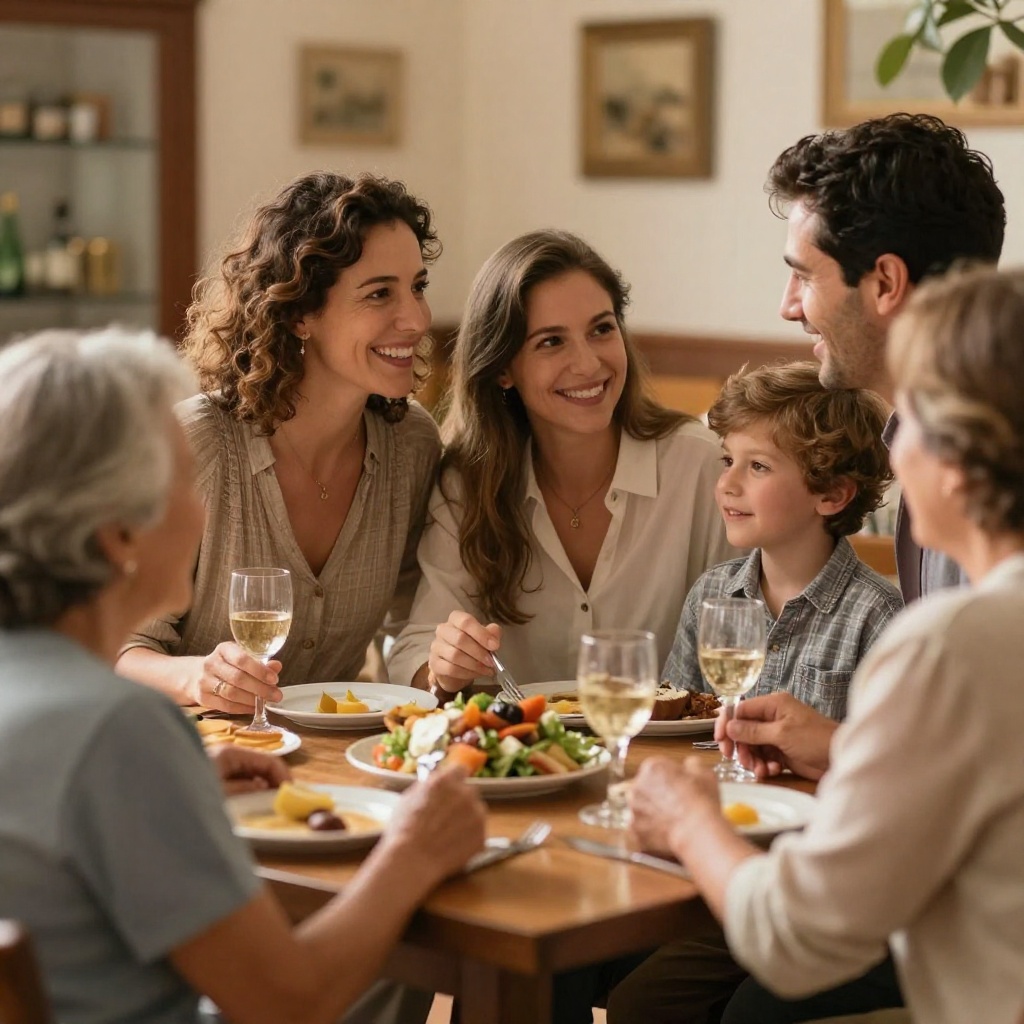
Spanish meals are long, social affairs. Dinner typically starts late (9-10 PM) and can last hours.
Pronunciation: ke BWE-na PEEN-ta TYE-ne ES-to
"¡Qué buena pinta tiene esto! ¿Qué es?"
Pronunciation: es-TA ree-KEE-see-mo
"¡Está riquísimo! ¿Cuál es la receta?"
Pronunciation: PWE-do re-pe-TEER
"¿Puedo repetir? Está muy rico."
The Late Dinner
Spanish dinners are LATE by most standards. Don't be surprised if dinner starts at 9 or 10 PM! Eat a snack beforehand if needed. Also, expect sobremesa - the post-meal conversation that can last an hour or more. Don't rush to leave!
Table Manners
| Do This | Why |
|---|---|
| Keep hands on the table | Spanish custom (not in lap) |
| Engage in conversation | Meals are social events |
| Stay for sobremesa | Post-meal chat is essential |
| Try everything | Shows appreciation |
Family Vocabulary
| Spanish | Pronunciation | English |
|---|---|---|
| la madre / mamá | la MA-dre / ma-MA | Mother / Mom |
| el padre / papá | el PA-dre / pa-PA | Father / Dad |
| la abuela | la a-BWE-la | Grandmother |
| el abuelo | el a-BWE-lo | Grandfather |
| el hermano | el er-MA-no | Brother |
| la hermana | la er-MA-na | Sister |
| la tía | la TEE-a | Aunt |
| el tío | el TEE-o | Uncle |
| la suegra | la SWE-gra | Mother-in-law |
| el suegro | el SWE-gro | Father-in-law |
Talking About Yourself
Pronunciation: soy deh
"Soy de Estados Unidos / Inglaterra / Canadá."
Pronunciation: es-TOY a-pren-DYEN-do es-pa-NYOL
"Estoy aprendiendo español porque quiero mucho a su hija/hijo."
Pronunciation: tra-BA-ho KO-mo
"Trabajo como ingeniero / profesor / programador."
Polite Responses
| Spanish | English | When to Use |
|---|---|---|
| Sí, por favor | Yes, please | Accepting offers |
| Con mucho gusto | With pleasure | Enthusiastic agreement |
| Gracias, pero... | Thank you, but... | Polite decline |
| Encantado/a | Delighted | For invitations |
Handling Wine and Toasts
Wine is central to Spanish meals. Here's how to participate:
Pronunciation: sa-LOOD
"¡Salud! Por la familia."
Pronunciation: por la fa-MEE-lya
"¡Por la familia! ¡Salud!"
Never Empty Your Own Glass
In Spain, it's polite to fill others' glasses before your own. If your glass is empty, wait for someone to offer - or simply gesture toward the bottle. Also, never toast with water - it's considered bad luck!
Saying Goodbye
Pronunciation: MOO-chas GRA-thias por TO-do
"Muchas gracias por todo. Ha sido una velada maravillosa."
Pronunciation: es-PE-ro ke nos BE-a-mos PRON-to
"Espero que nos veamos pronto. Me ha encantado conocerles."
Pronunciation: oon pla-THER a-BER-les ko-no-THEE-do
"Un placer haberles conocido. Hasta pronto."
Things to Avoid
Meeting the family can be nerve-wracking, but knowing what NOT to do is just as important as knowing the right phrases. Spanish families are generally forgiving of cultural mistakes, but avoiding these common errors will help you make the best impression.
Pronunciation: no me GOO-sta
"No me gusta el café amargo."
First, timing matters enormously. Leaving immediately after eating signals disinterest in the family. Sobremesa—the conversation time after the meal—is when real bonding happens. Plan to stay at least an hour after finishing your food. Checking your watch or phone repeatedly sends a terrible message.
Food-related mistakes can be particularly awkward. Never criticize food, even as a joke. If you can't eat something due to allergies, explain politely beforehand: "Soy alérgico/a a..." (I'm allergic to...). But general pickiness? Keep it to yourself. Try everything offered, even if just a small portion.
Pronunciation: a ke O-ra nos BA-mos
"¿A qué hora nos vamos de la fiesta?"
Controversial topics deserve careful handling. Politics, especially regional politics (Catalonia, Basque independence), can be explosive. Religion, while important in some families, shouldn't be debated at first meetings. Economic situations, unemployment, or salary questions—all off-limits initially. Stick to safe topics: travel, food, their region's beauty, your interest in Spanish culture.
Regional Sensitivities
Spain isn't monolithic. Don't call Barcelona "Spain" to proud Catalans, don't dismiss regional languages as "dialects," and learn the difference between a Basque and a Spaniard if relevant. Regional identity runs deep!
Don't:
- Rush the meal - Spanish dinners take hours
- Leave right after eating - Stay for sobremesa
- Criticize food - Even jokingly
- Discuss controversial topics - Politics, Catalonia, etc. on first meeting
- Be too reserved - Warmth is valued
Do:
- Be warm and expressive - Spanish culture is effusive
- Ask about family - They love talking about relatives
- Compliment the food - Multiple times!
- Try speaking Spanish - They'll adore your effort
- Show interest in their region - Spain is regionally proud
Regional Pride
Spain has strong regional identities. If your partner's family is from Catalonia, the Basque Country, Galicia, or Andalusia, show interest in their specific region. Ask about local traditions, food specialties, and maybe learn a phrase in their regional language if applicable!
Sample Conversation
You: ¡Hola! Encantado de conocerles.
Parents: ¡Hola! Bienvenido/a. Pasa, pasa.
You: Les he traído vino.
Mom: ¡Ay, qué detalle! Muchas gracias.
You: He oído hablar mucho de ustedes.
Dad: Siéntate. ¿Qué quieres tomar?
You: Lo que ustedes tomen, por favor.
Good luck meeting the family! With warmth, good manners, and a few Spanish phrases, you'll make a wonderful impression. If you are speaking as a woman, use Encantada de conocerles instead of Encantado de conocerles.
Related Articles
Ready to learn together?
Speak their language, touch their heart. Fun games, voice practice & goals made for two.
Start Learning for $0.00 →✨ Try free — no credit card needed
Frequently Asked Questions
Besides kissing, what are other appropriate ways to greet family members in Spanish-speaking cultures?
The number of kisses (one or two) and whether you kiss at all depends on the country and the family's customs. A handshake is generally acceptable for more formal introductions or with older relatives. A warm hug is also common, especially after the initial meeting. Observe how your partner greets their family and follow their lead.
What are some good conversation starters when meeting my partner's family in Spanish?
Ask about their interests, hobbies, or their region of origin. Compliment their home or the food they've prepared. Avoid controversial topics like politics or religion. Showing genuine interest in getting to know them is key. For example, ask '¿Qué le gusta hacer en su tiempo libre?' (What do you like to do in your free time?).
What kind of gifts are generally considered appropriate when meeting a Spanish partner's family for the first time?
Bringing a small gift is a thoughtful gesture. Flowers, a bottle of wine, or a regional specialty from your own country are usually well-received. Avoid bringing expensive or overly personal gifts, as this can be seen as presumptuous. The gesture of bringing something is more important than the gift itself.
What are some important table manners to keep in mind when dining with my partner's family in Spain?
Keep your hands above the table, but not in your lap. Wait for everyone to be served before you start eating. Don't cut your food into small pieces all at once. Offer to help clear the table after the meal. Compliment the cook on the food. These small gestures show respect and appreciation.
How can couples prepare together for meeting each other's families and navigating cultural differences?
Have open and honest conversations about your family's customs and expectations. Role-play common scenarios, such as greetings, gift-giving, and mealtime conversations. This will help you both feel more prepared and confident. Support each other and be patient with any cultural misunderstandings that may arise.