Spanish Shopping Vocabulary for Couples
Master Spanish shopping vocabulary together! Learn essential phrases for markets, malls, and boutiques to enjoy shopping adventures in Spanish-speaking countries.
Shopping together as a couple is one of life's simple pleasures, whether you're browsing local markets for souvenirs, picking out gifts for each other, or exploring fashion boutiques in a Spanish-speaking city. Knowing the right vocabulary transforms a potentially frustrating experience into an enjoyable adventure.
Learning shopping Spanish together means you can help each other navigate stores, bargain at markets, and find exactly what you're looking for without stress.
Entering a Store
When walking into a boutique or shop in a Spanish-speaking country, the interaction typically begins with a formal acknowledgment. Unlike large self-service retailers, smaller shops often prioritize a polite exchange between the customer and the staff. This section introduces the foundational greetings you will encounter upon entry and the first phrases necessary to communicate whether you are looking for a specific item or simply browsing the aisles.
Establishing a polite tone early sets the stage for a smooth shopping experience. You will find phrases for responding to store clerks who offer assistance and the appropriate vocabulary for initiating a conversation.
Pronunciation: de-pen-DYEN-te
"El dependiente es muy amable."
Greetings and First Phrases
| Spanish | English |
|---|---|
| Buenas tardes | Good afternoon |
| Solo estamos mirando | We're just looking |
| ¿Nos puede ayudar? | Can you help us? |
| Busco... | I'm looking for... |
| Buscamos... | We're looking for... |
| ¿Dónde puedo encontrar...? | Where can I find...? |
| ¿Tienen...? | Do you have...? |
Pronunciation: SOH-loh ehs-TAH-mohs mee-RAHN-doh
"Gracias, solo estamos mirando por ahora."
Phrase to Learn
¿Me lo puedo probar?
Can I try it on?
[ meh loh PWEH-doh proh-BAHR ]
Essential phrase for trying on clothes or accessories
Clothing (La Ropa)
Building a functional wardrobe in another language requires a broad knowledge of different garment types. This section breaks down the vocabulary into manageable categories, starting with basic clothing items like shirts and pants that form the core of any outfit. We will then expand into more clothing options, covering seasonal wear and specific pieces you might encounter in a fashion-forward environment.
To round out your knowledge, we also explore accessories (los accesorios). These items, ranging from belts to jewelry, are often found in separate sections of a store and require their own specific terminology. Mastering these terms ensures you can locate exactly what you need without relying on gestures.
Pronunciation: la PREN-da
"Esta prenda es de algodón."
Basic Clothing Items
| Spanish | English |
|---|---|
| la camisa | shirt |
| la camiseta | t-shirt |
| los pantalones | pants |
| los jeans / los vaqueros | jeans |
| el vestido | dress |
| la falda | skirt |
| el suéter | sweater |
| la chaqueta | jacket |
| el abrigo | coat |
| los shorts | shorts |
More Clothing
| Spanish | English |
|---|---|
| la blusa | blouse |
| el traje | suit |
| la corbata | tie |
| el cinturón | belt |
| los calcetines | socks |
| la ropa interior | underwear |
| el pijama | pajamas |
| el bañador / traje de baño | swimsuit |
Pronunciation: ehl behs-TEE-doh
"Ese vestido te queda perfecto, mi amor."
Accessories (Los Accesorios)
| Spanish | English |
|---|---|
| los zapatos | shoes |
| las zapatillas | sneakers |
| las botas | boots |
| las sandalias | sandals |
| los tacones | heels |
| el bolso / la bolsa | bag/purse |
| el sombrero | hat |
| la gorra | cap |
| el reloj | watch |
| las gafas de sol | sunglasses |
| la bufanda | scarf |
| los guantes | gloves |
Shopping Hours
In Spain, many stores close for siesta (around 2-5 PM) and stay open until 8-9 PM. On Sundays, most stores are closed except in tourist areas. In Latin America, hours vary more but Sunday shopping is common in malls. Always check "horario" (hours) before heading out!
Sizes and Fit
Navigating international sizing can be a challenge, as standards often differ from those in English-speaking countries. Understanding how to communicate your needs regarding the dimensions of a garment is essential for finding the right look. This section details the process of asking about size and introduces the specific size terms used for small, medium, and large items.
Beyond just the number or letter on the tag, how a piece of clothing sits on the body is equally important. We will cover vocabulary for describing fit, allowing you to explain if a sleeve is too long, a waist is too tight, or if the overall silhouette is just right.
Pronunciation: el bes-ti-DOR
"¿Dónde está el vestidor?"
Asking About Size
| Spanish | English |
|---|---|
| ¿Qué talla usas? | What size do you wear? |
| ¿Qué número calzas? | What shoe size do you wear? |
| ¿Tiene una talla más grande? | Do you have a larger size? |
| ¿Tiene una talla más pequeña? | Do you have a smaller size? |
| ¿Tiene esto en otro color? | Do you have this in another color? |
| No tenemos su talla | We don't have your size |
Pronunciation: keh TAH-yah OO-sahs
"Amor, ¿qué talla usas? Te quiero comprar algo."
Size Terms
| Spanish | English |
|---|---|
| pequeño/a (P) | small (S) |
| mediano/a (M) | medium (M) |
| grande (G) | large (L) |
| extra grande (XG) | extra large (XL) |
| talla única | one size |
| la talla | clothing size |
| el número | shoe size |
Describing Fit
| Spanish | English |
|---|---|
| Me queda bien | It fits me well |
| Me queda grande | It's too big on me |
| Me queda pequeño/apretado | It's too small/tight |
| Te queda perfecto | It looks perfect on you |
| Me queda largo/corto | It's too long/short |
| ¿Cómo me queda? | How does it look on me? |
Phrase to Learn
Te queda muy bien
It looks great on you
[ teh KEH-dah mwee bee-EHN ]
The perfect compliment when your partner tries something on
Colors (Los Colores)
| Spanish | English |
|---|---|
| negro/a | black |
| blanco/a | white |
| rojo/a | red |
| azul | blue |
| verde | green |
| amarillo/a | yellow |
| naranja / anaranjado | orange |
| rosa / rosado | pink |
| morado / púrpura | purple |
| marrón / café | brown |
| gris | gray |
| beige | beige |
| dorado | gold |
| plateado | silver |
Pronunciation: loh tee-EH-nehn ehn OH-troh koh-LOHR
"Me gusta este diseño. ¿Lo tienen en azul?"
Paying and Prices
The final step of any shopping trip involves the financial transaction, which requires clear communication to ensure you pay the correct amount. This section focuses on the logistical side of the experience, starting with asking about price for items that may not have visible tags. You will learn the common structures used to inquire about costs in various retail settings.
Once the price is established, you must navigate making payment. This involves understanding the terms for different payment methods, such as cash or credit cards, and handling the exchange of receipts. Familiarity with these terms prevents confusion at the register.
Pronunciation: e-fek-TEE-bo
"Solo aceptamos pago en efectivo."
Asking About Price
| Spanish | English |
|---|---|
| ¿Cuánto cuesta? | How much does it cost? |
| ¿Cuánto es? | How much is it? |
| ¿Cuál es el precio? | What's the price? |
| ¿Tiene descuento? | Is there a discount? |
| ¿Está en oferta? | Is it on sale? |
| Es muy caro | It's very expensive |
| Es una ganga | It's a bargain |
| ¿Me hace un descuento? | Can you give me a discount? |
Pronunciation: KWAHN-toh KWEHS-tah
"Disculpe, ¿cuánto cuesta este collar?"
Making Payment
| Spanish | English |
|---|---|
| ¿Dónde está la caja? | Where is the register? |
| ¿Aceptan tarjeta? | Do you accept cards? |
| Solo efectivo | Cash only |
| ¿Puedo pagar con tarjeta? | Can I pay by card? |
| ¿Tienen WiFi para pagar? | Do you have WiFi to pay? |
| ¿Me da un recibo? | Can I have a receipt? |
| ¿Es reembolsable? | Is it refundable? |
| ¿Cuál es la política de devolución? | What's the return policy? |
Bargaining Culture
Bargaining is common in markets (mercados) throughout Latin America and some parts of Spain. In regular stores, prices are fixed. At markets, try "¿Me hace un descuento?" (Can you give me a discount?) or "¿Cuál es su mejor precio?" (What's your best price?). Be friendly and respectful - it's a social exchange!
At the Market (En el Mercado)
Shopping at an outdoor or traditional market offers a different cultural experience than a standard retail store. The environment is often louder and more interactive, requiring a specialized set of market vocabulary. This section covers the terms for fresh produce, artisanal goods, and the unique layout of market stalls (puestos).
In many traditional markets, price negotiation is a standard part of the interaction. We provide specific bargaining phrases that allow you to engage in this cultural practice respectfully. Understanding these linguistic nuances helps you navigate the fast-paced nature of local commerce.
Pronunciation: el PWES-to
"Hay fruta fresca en aquel puesto."
Market Vocabulary
| Spanish | English |
|---|---|
| el mercado | the market |
| el puesto | the stall/stand |
| el vendedor | the vendor |
| artesanías | handicrafts |
| recuerdos / souvenirs | souvenirs |
| hecho a mano | handmade |
| local | local |
| típico | traditional |
Bargaining Phrases
| Spanish | English |
|---|---|
| ¿Cuál es su mejor precio? | What's your best price? |
| Es muy caro para mí | It's too expensive for me |
| ¿Me puede hacer un descuento? | Can you give me a discount? |
| Si compro dos, ¿hay descuento? | If I buy two, is there a discount? |
| Le doy [amount] | I'll give you [amount] |
| Es mi última oferta | It's my final offer |
| Déjeme pensarlo | Let me think about it |
| Vamos a buscar en otro lado | We'll look somewhere else |
Pronunciation: EH-choh ah MAH-noh
"Me encantan las artesanías hechas a mano."
Shopping Together as a Couple
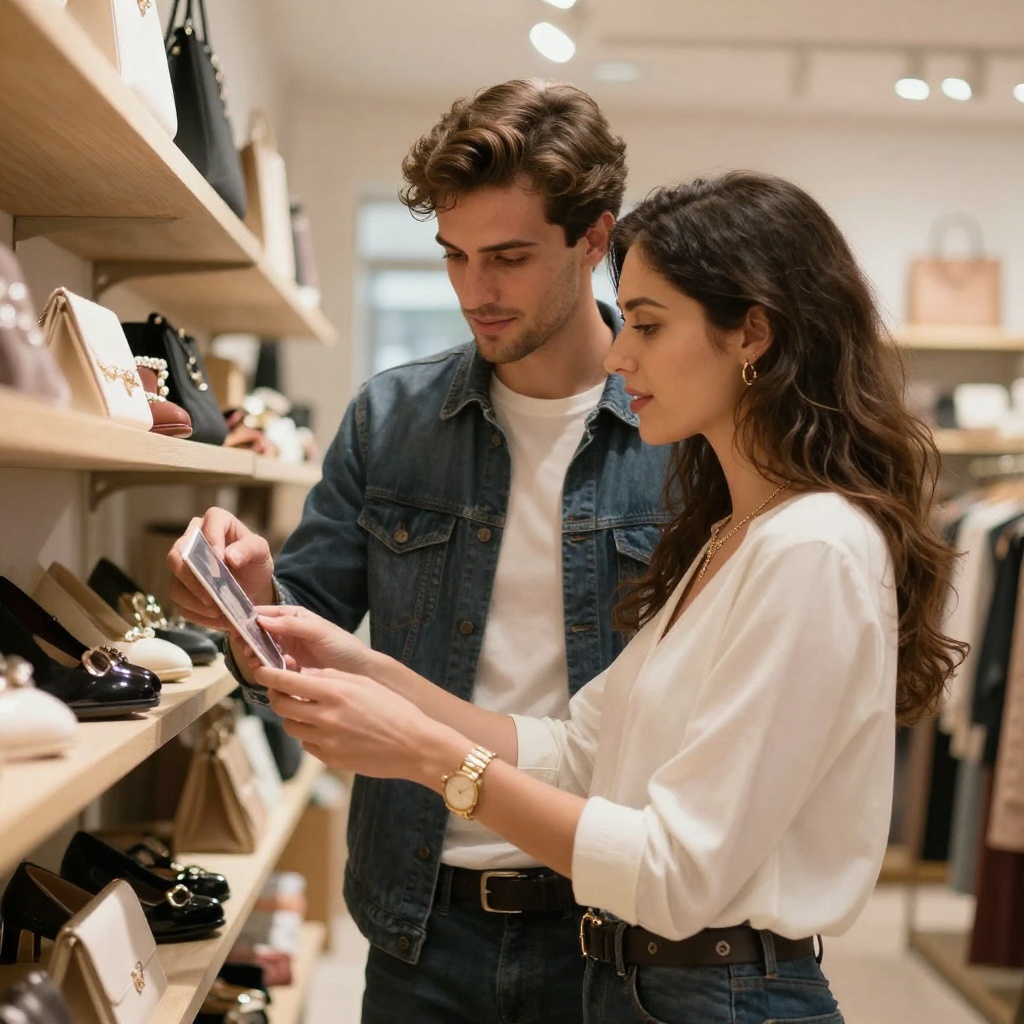
When shopping as a pair, the dialogue shifts from interacting with staff to communicating with your partner. This social dynamic requires phrases that allow you to share your thoughts on various items. This section focuses on the language needed for asking opinions, ensuring you can effectively invite your partner's input on a potential purchase.
Equally important is the ability to provide clear feedback. We cover the vocabulary for giving opinions, whether you are offering a compliment or suggesting that a different style might be better. This collaborative vocabulary makes the shopping trip a shared linguistic exercise.
Pronunciation: KO-mo me KE-da
"¿Cómo me queda esta chaqueta?"
Asking Opinions
| Spanish | English |
|---|---|
| ¿Qué te parece? | What do you think? |
| ¿Te gusta? | Do you like it? |
| ¿Cuál prefieres? | Which do you prefer? |
| ¿Este o ese? | This one or that one? |
| ¿Me queda bien? | Does it look good on me? |
| ¿Qué color me queda mejor? | What color looks better on me? |
| ¿Debería comprarlo? | Should I buy it? |
| ¿Es demasiado? | Is it too much? |
Phrase to Learn
Ese color te queda increíble
That color looks amazing on you
[ EH-seh koh-LOHR teh KEH-dah een-kreh-EE-bleh ]
A loving compliment while shopping together
Giving Opinions
| Spanish | English |
|---|---|
| Te queda muy bien | It looks great on you |
| No me convence | I'm not convinced |
| Me encanta | I love it |
| Es perfecto para ti | It's perfect for you |
| No es tu estilo | It's not your style |
| Prefiero el otro | I prefer the other one |
| ¡Cómpralo! | Buy it! |
| Busquemos algo más | Let's look for something else |
Pronunciation: teh behs een-kreh-EE-bleh
"Amor, ¡te ves increíble con ese vestido!"
Types of Stores
| Spanish | English |
|---|---|
| el centro comercial | shopping mall |
| la tienda | store |
| la boutique | boutique |
| la tienda de ropa | clothing store |
| la zapatería | shoe store |
| la joyería | jewelry store |
| la perfumería | perfume store |
| la tienda de regalos | gift shop |
| el supermercado | supermarket |
| la farmacia | pharmacy |
| la librería | bookstore |
El Corte Inglés
If you're in Spain, "El Corte Inglés" is the famous department store chain found in most cities. It's a great place to shop because staff often speak English, and you can find everything from clothing to electronics to gourmet food under one roof.
Practice Dialogue: Shopping for a Gift
Shop assistant: Buenas tardes, ¿les puedo ayudar en algo?
You: Sí, buscamos un regalo para mi suegra.
Partner: Algo especial, como una bufanda o un bolso.
Shop assistant: Tenemos unas bufandas de seda muy bonitas. ¿De qué color buscan?
You: ¿Qué te parece azul, amor? Le gusta el azul.
Partner: Sí, perfecto. ¿Nos muestra las azules?
Shop assistant: Claro, aquí tienen. Esta es de seda pura, hecha a mano.
You: ¡Qué bonita! ¿Cuánto cuesta?
Shop assistant: Está a 45 euros, pero hoy tenemos un 20% de descuento.
Partner: Entonces queda en 36 euros, ¿verdad?
Shop assistant: Exacto. ¿Se la llevo a caja?
You: Sí, por favor. Y si tiene una bolsita de regalo...
Shop assistant: Por supuesto, se la envuelvo para regalo.
Useful Shopping Phrases Summary
| Spanish | English |
|---|---|
| ¿Dónde están los probadores? | Where are the fitting rooms? |
| Voy a pensarlo | I'll think about it |
| Me lo llevo | I'll take it |
| No, gracias | No, thank you |
| ¿Tienen garantía? | Do you have a warranty? |
| ¿Puedo ver ese? | Can I see that one? |
| Estamos buscando... | We're looking for... |
| ¿Abren los domingos? | Are you open on Sundays? |
Make Shopping an Adventure
Shopping in Spanish-speaking countries is about more than just buying things - it's a cultural experience. From chatting with friendly vendors at local markets to exploring elegant boutiques, speaking Spanish opens doors and creates memorable moments together.
Remember to be patient with yourselves, have fun practicing these phrases, and enjoy the adventure of discovering new places and treasures as a couple!
Related Articles
Ready to learn together?
Speak their language, touch their heart. Fun games, voice practice & goals made for two.
Start Learning for $0.00 →✨ Try free — no credit card needed
Frequently Asked Questions
How can my partner and I practice Spanish shopping phrases before our trip?
Role-play shopping scenarios at home, taking turns being the shopkeeper and the customer. Create a mock shopping list in Spanish and practice asking for the items and their prices. Use online resources to find audio pronunciations of the phrases and repeat them together.
What are some cultural differences to be aware of when shopping in Spanish-speaking countries?
Bargaining is common in markets in many Latin American countries, but less so in department stores in Spain. Dress codes can vary depending on the type of store and the region. It's also customary to greet the shopkeeper when entering a store and thank them upon leaving.
How do I ask if a store has a specific item in Spanish?
You can say "¿Tiene(n) [item]?" (Do you have [item]?) or "¿Podría decirme si tienen [item]?" (Could you tell me if you have [item]?). Be specific about the item you're looking for and use the correct gender article (el/la) for the noun.
What's the best way to ask for a discount in Spanish?
You can say "¿Hay algún descuento?" (Is there any discount?) or "¿Me puede hacer un precio mejor?" (Can you give me a better price?). Be polite and respectful, and remember that bargaining is more acceptable in some settings than others.
How do I ask for a different size of clothing in Spanish?
You can say "¿Tiene(s) esto en talla [number]?" (Do you have this in size [number]?) or "¿Me puede mostrar una talla más grande/pequeña?" (Can you show me a bigger/smaller size?). Knowing your size in the European system will be helpful.