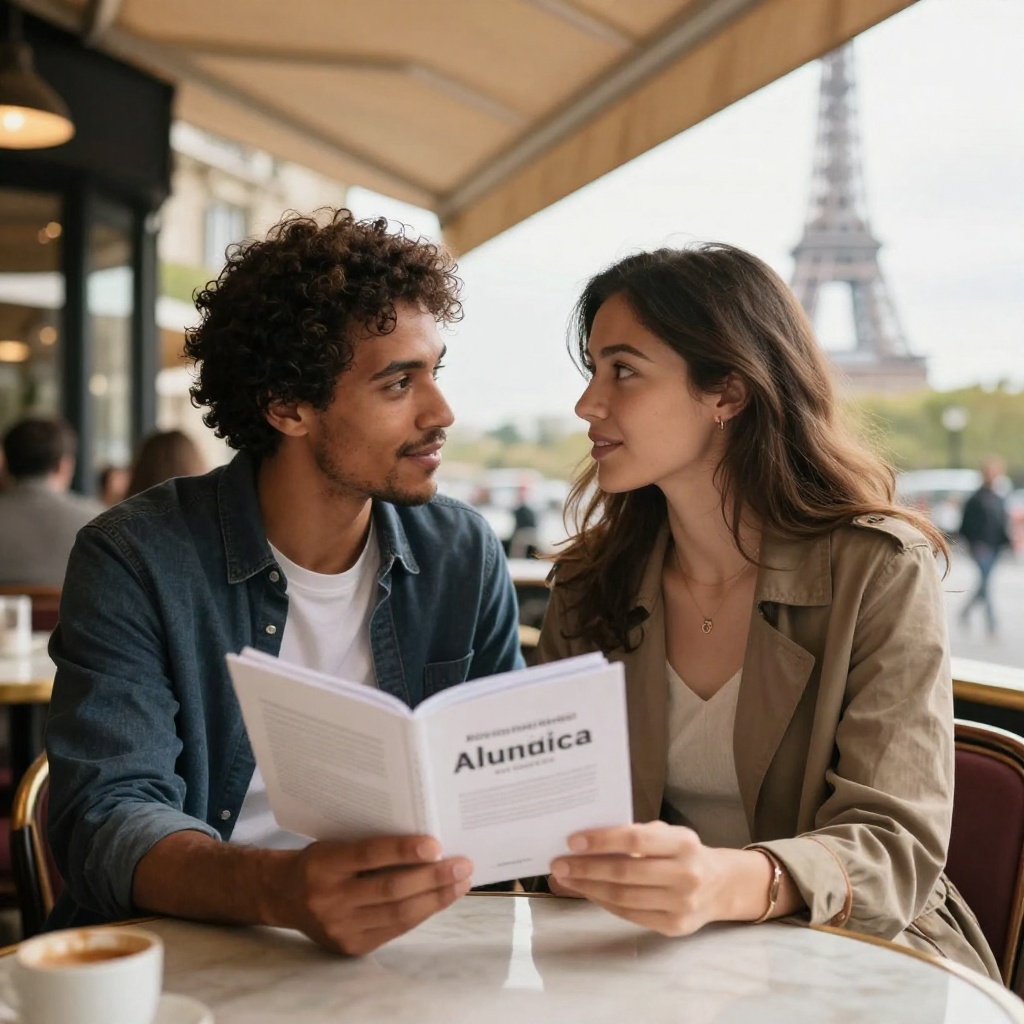
French Greetings and Goodbyes Guide
Learn romantic French greetings and goodbyes perfect for couples. Master essential phrases, cultural etiquette, and sweet expressions together. Bonjour l'amour!
Learning French together as a couple opens doors to romance, culture, and deeper connection. Whether you're planning a trip to Paris or simply want to add some je ne sais quoi to your relationship, mastering French greetings and goodbyes is the perfect starting point for your linguistic journey together.
Why Learn French Greetings as a Couple?
French greetings aren't just words—they're gateways to understanding French culture, romance, and social etiquette. When couples learn together, you create shared experiences, practice opportunities, and romantic moments that strengthen both your relationship and language skills.
Essential French Greetings for Every Occasion
A French person who hears bonjour at 9 PM will wince — not because the word is wrong, but because it is precisely the wrong time to use it. French greetings are time-stamped in a way that English ones simply are not. Bonjour belongs to daylight hours, bonsoir takes over as evening falls, and mixing them up signals to every French speaker in the room that you are a beginner.
The dividing line between bonjour and bonsoir is not fixed at a specific hour — it shifts with the seasons and even with the speaker's perception. In summer, when the sun sets at 10 PM, some people keep saying bonjour until 7 or 8 PM. In winter, bonsoir can start as early as 5 PM. The safest rule: if the light outside looks like evening, switch to bonsoir. And here is a detail most textbooks skip — when entering a shop in France, you are expected to greet the staff with bonjour (or bonsoir). Not doing so is considered rude, almost aggressive. It is one of the most commonmost commonmost commonmost commonmost common cultural missteps English speakers make.
Morning Greetings
Start your day with these beautiful French morning greetings:
Pronunciation: bun mah-tee-NAY
"Bonne matinée, à tout à l'heure!"
Afternoon and Evening Greetings
Romantic Greetings for Couples
French couples greet each other with a warmth that goes far beyond bonjour. Where an English speaker might say "hey babe" or "hi love," a French speaker has an entire vocabulary of pet names woven directly into their greetings — and each one carries a slightly different emotional charge. Mon coeur (my heart), mon amour (my love), ma puce (my flea — yes, really) all function as greetings when paired with a kiss on the forehead or a voice message.
What catches most English speakers off guard is that these terms are gendered. Mon amour uses the masculine mon even when addressing a woman, because amour is a masculine noun. But ma chérie (my darling, to a woman) uses the feminine ma because chérie is feminine. Getting this wrong will not cause offense — your partner will find it charming — but getting it right shows a level of care that French speakers notice and appreciate deeply.
Terms of Endearment in Greetings
French couples often include terms of endearment in their greetings. Here are the most common ones:
| French Term | Pronunciation | English Translation | When to Use |
|---|---|---|---|
| Mon amour | [mon na-MOOR] | My love | Any time, very romantic |
| Mon chéri/Ma chérie | [mon shay-REE] | My dear/darling | Daily affection |
| Mon cœur | [mon KUR] | My heart | Intimate moments |
| Ma belle/Mon beau | [ma BELL/mon BOH] | My beautiful one | Complimentary greeting |
Phrase to Learn
Bonjour mon amour
Good morning my love
[ bohn-ZHOOR mohn ah-MOOR ]
Perfect romantic morning greeting for your partner
The Art of French Kissing... Greetings!
In France, greeting with kisses on the cheek (la bise) is common among friends and family. The number of kisses varies by region—Paris typically does two, starting with the right cheek. For couples learning French culture, practice this greeting to understand French social customs!
Formal vs. Informal Greetings
Understanding when to use formal versus informal greetings is crucial in French culture:
Formal Greetings
- Bonjour Monsieur/Madame [bon-ZHOOR muh-SYUH/ma-DAM] - Good day Sir/Madam
- Bonsoir Monsieur/Madame [bon-SWAHR muh-SYUH/ma-DAM] - Good evening Sir/Madam
- Enchanté(e) [ahn-shahn-TAY] - Pleased to meet you
Informal Greetings
- Salut [sa-LUU] - Hi/Bye
- Coucou [koo-KOO] - Hey there (very casual)
- Ça va? [sa VAH] - How's it going?
Beautiful French Goodbyes
The French goodbye is an event. Where Americans might wave and walk away mid-sentence, the French treat departures as mini-ceremonies requiring their own vocabulary, their own rhythm, and often their own set of kisses. The word au revoir (goodbye, literally "until re-seeing") is just the beginning — it is the plain vanilla option in a menu full of flavors.
The distinction between au revoir and adieu is one that many English speakers get dangerously wrong. Adieu does not simply mean "farewell" — it carries the weight of finality. Etymologically, it means "to God" (à Dieu), implying you are committing the other person to God's care because you may never see them again. Using adieu casually with your French partner's family would create an awkward silence. Stick with au revoir for standard goodbyes, à bientôt (see you soon) for warmer ones, and save adieu for dramatic moments in novels.
Standard Farewells
Pronunciation: ah too-tah-LUR
"À tout à l'heure, bon travail!"
Romantic Farewells
Pronunciation: zhuh TEHM
"Je t'aime, passe une belle journée."
Pronunciation: tuu vah muh mahn-KAY
"Tu vas me manquer, reviens vite!"
Time-Specific Goodbyes
French has a goodbye for every time of day and every degree of certainty about when you will meet again. Bonne nuit (good night) is only used when someone is actually going to sleep — say it to someone leaving a dinner party at 9 PM and they will look at you oddly, as if you just told them to go to bed. The correct choice at that hour is bonne soirée (have a good evening), which wishes them well for the remaining evening hours.
This bonne + time period formula is one of the most productive patterns in French. Bonne journée (have a good day), bon après-midi (good afternoon), bonne soirée (have a good evening), bonne nuit (good night) — each one precisely calibrated to the hours ahead. The pattern works because bonne means "good" in the feminine form (matching the feminine nouns nuit, soirée, journée), while bon is masculine (matching après-midi). Mastering this system gives you a goodbye for literally every moment of the day.
Evening and Night Farewells
Pronunciation: dor bee-AHN
"Dors bien ma chérie, à demain."
French Time Etiquette
"Bonne nuit" is only used when someone is actually going to sleep, unlike English where "good night" can be used as a general evening farewell. Use "bonsoir" for evening goodbyes when you're not going to bed!
Interactive Dialogue Practice for Couples
Here's a romantic morning dialogue you can practice together:
Partner A: Bonjour mon amour, as-tu bien dormi? [bon-ZHOOR mon na-MOOR, ah-tuu bee-AHN dor-MEE?] (Good morning my love, did you sleep well?)
Partner B: Oui, très bien merci. Et toi, mon cœur? [wee, tray bee-AHN mer-SEE. ay TWAH, mon KUR?] (Yes, very well thank you. And you, my heart?)
Partner A: Parfaitement, surtout dans tes bras. [par-fet-MAHN, suur-TOO dahn tay BRAH] (Perfectly, especially in your arms.)
Evening Goodbye Dialogue
Partner A: Je dois y aller maintenant. Tu vas me manquer. [zhuh dwah zee ah-LAY man-tuh-NAHN. tuu vah muh mahn-KAY] (I have to go now. I'm going to miss you.)
Partner B: Toi aussi. À tout à l'heure, je t'aime. [twah oh-SEE. ah too tah LUR, zhuh TEHM] (Me too. See you later, I love you.)
Common Mistakes to Avoid
- Don't use "Bonne nuit" as a general goodbye - It's specifically for bedtime
- Remember the liaison - "Bon" becomes "bonn" before vowels (Bonne après-midi)
- Match the formality level - Don't mix "salut" with "Monsieur/Madame"
- Use appropriate terms of endearment - Some are more intimate than others
Cultural Context: French Greeting Customs
Regional Variations
French greetings can vary significantly by region. In the South, people tend to be more warm and expressive, while Northern regions may be more reserved. When visiting different French regions as a couple, observe local customs and adapt accordingly!
Practice Exercises for Couples
The fastest way to internalize French greetings is not flashcards — it is using them at the moments they are meant for. When you wake up next to your partner, say bonjour, mon coeur instead of "good morning." When you leave for work, try à ce soir (see you tonight) instead of "bye." These micro-switches build muscle memory faster than any textbook exercise.
There is a reason immersion works better than study: greetings are tied to physical moments — waking up, arriving, leaving, going to sleep. Your brain encodes language more deeply when it is linked to a sensory experience. The smell of morning coffee paired with bonjour creates a stronger neural pathway than reading bonjour on a screen fifty times. Use your daily routine as a scaffolding for French, and the greetings will become automatic within weeks, not months.
Morning Routine Challenge
For one week, greet each other only in French every morning. Start with basic "Bonjour" and gradually add terms of endearment and longer phrases.
Role-Play Scenarios
- Meeting French friends - Practice formal introductions
- Café encounter - Greet the waiter and each other
- Bedtime ritual - Sweet French goodnights
Memory Game
Take turns saying a French greeting or goodbye. Your partner must respond appropriately and add a term of endearment. Keep the conversation going as long as possible!
Building Your French Foundation Together
Here is a quick recap you can practice as a couple:
- Bonjour - use it during the day with anyone
- Bonsoir - switch to it in the evening
- Salut - keep it for informal settings
- Bonne nuit - save it for bedtime
- À bientôt - use it when you expect to see each other again soon
Try saying these phrases during your actual routine this week: when you wake up, leave the house, and say goodnight. The more you attach them to real moments, the faster they will stick.
Bonne chance et bon courage dans votre apprentissage du français !
Ready to learn together?
Speak their language, touch their heart. Fun games, voice practice & goals made for two.
Start Learning for $0.00 →✨ Try free — no credit card needed
Frequently Asked Questions
How do French greetings differ between regions, like Paris versus the countryside?
In Paris, greetings tend to be a bit more formal and reserved, especially in professional settings. In the countryside, greetings can be warmer and more relaxed, with more emphasis on physical contact like "la bise" (cheek kiss). Observe how locals greet each other to adapt your approach accordingly.
What's the best way to handle greetings in a formal business setting in France?
In a formal business setting, a handshake is generally the most appropriate greeting. Maintain eye contact and offer a firm but not overly strong handshake. Use formal titles like "Monsieur" or "Madame" followed by the person's last name. Avoid using informal greetings or terms of endearment unless invited to do so.
How can couples make learning French greetings more interactive and fun?
Create flashcards with different greeting scenarios and practice responding appropriately. Role-play common situations, such as meeting a friend for coffee or greeting a colleague at work. Use online resources like language learning apps or videos to hear native speakers pronounce the greetings and practice your pronunciation.
Are there any common mistakes English speakers make when greeting people in French?
One common mistake is using informal greetings with people you don't know well. Another mistake is forgetting to use the correct level of formality, such as using "tu" (informal you) instead of "vous" (formal you). Pay attention to the context and the relationship you have with the person you're greeting.
Besides pronunciation, what other aspects of greetings are important to master?
Understanding the cultural context is crucial. Learn when to use "la bise" (cheek kiss) and how many kisses are customary in different regions. Be aware of the appropriate level of formality and adjust your language accordingly. Also, pay attention to non-verbal cues like body language and eye contact to convey respect and sincerity.