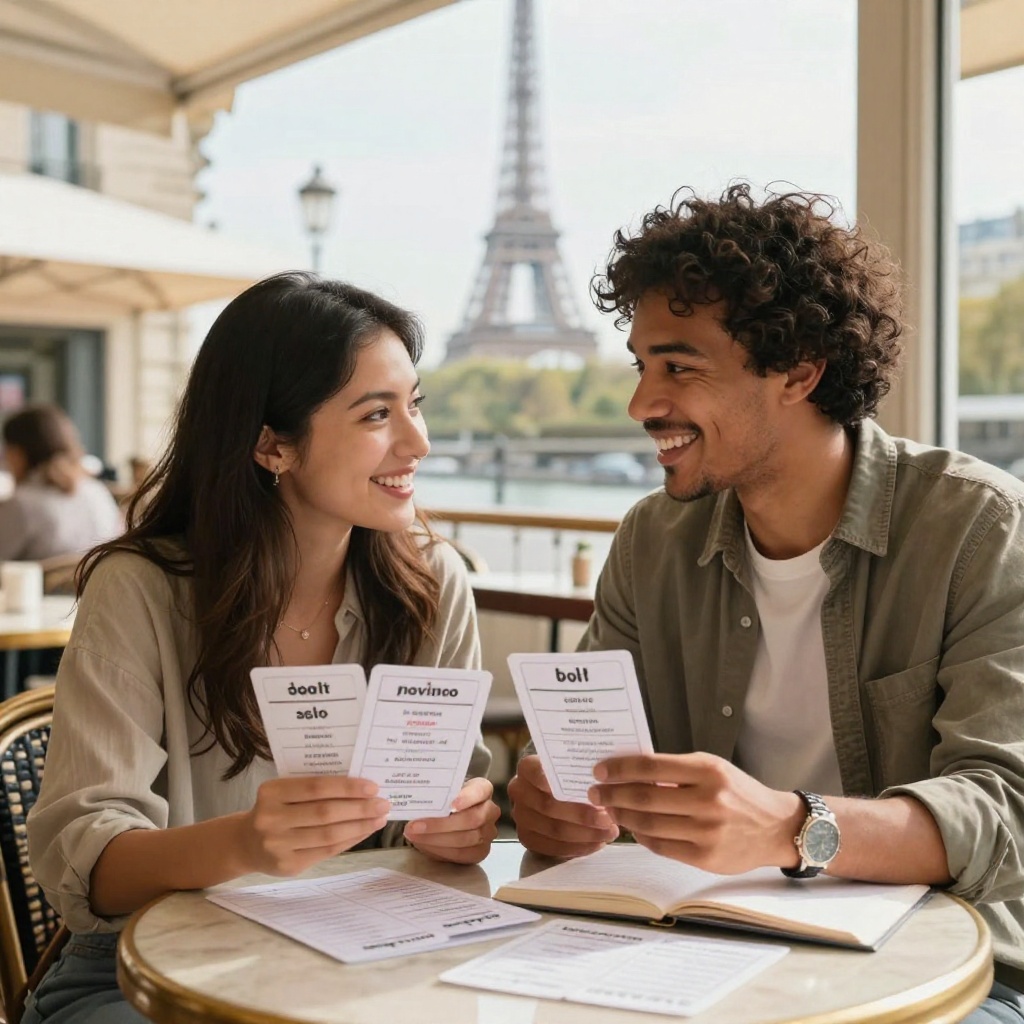
French Restaurant Vocabulary: Dining Out Guide for Couples
Master French dining vocabulary! Learn essential restaurant phrases, how to order food, read menus, and enjoy romantic dinners together in French.
Whether you're dreaming of a romantic dinner in Paris or simply want to impress your partner at your local French restaurant, mastering dining vocabulary is essential. From making reservations to savoring dessert, this guide will help you navigate the delicious world of French cuisine together.
Arriving at the Restaurant
Phrase to Learn
Bonsoir, nous avons une reservation
Good evening, we have a reservation
[ bohn-SWAHR noo-zah-VOHN oon ray-zehr-vah-see-OHN ]
The perfect opening line when arriving at a restaurant with a reservation
Making a Reservation
French restaurant staff will usually respond well to short, polite sentences. When you call ahead or book online, keep the request simple and include the number of people, the date, and the time.
| French | English | Pronunciation |
|---|---|---|
| Je voudrais réserver une table. | I would like to reserve a table. | [zhuh voo-DRAY ray-zair-VAY oon TAH-bluh] |
| Pour deux personnes. | For two people. | [poor duh pehr-SON] |
| Pour ce soir. | For tonight. | [poor suh SWAHR] |
| À quelle heure ? | At what time? | [ah kel UHR] |
| À vingt heures. | At 8 p.m. | [ah van TUHR] |
A useful pattern is Je voudrais réserver une table pour deux à huit heures, which sounds natural and polite.
Arriving Without a Reservation
If you are walking in, ask first whether a table is available, then add where you would prefer to sit. This is especially useful in busy bistros where the dining room may fill up quickly.
| French | English | Use |
|---|---|---|
| Est-ce que vous avez une table de libre ? | Do you have a table available? | First question when arriving without booking |
| On peut s'asseoir là ? | Can we sit there? | Useful if the host points to a table |
| Vous avez une table près de la fenêtre ? | Do you have a table near the window? | Good for a romantic request |
| Il y a combien de temps d'attente ? | How long is the wait? | Useful at busy times |
For a softer tone, you can combine the phrases: Bonsoir, est-ce que vous avez une table de libre pour deux ?
Pronunciation: ex-koo-ZAY-mwah ess-KEEL REST oon TAH-bluh poor DUH
"Bonsoir! Excusez-moi, est-ce qu'il reste une table pour deux?"
French Restaurant Hours
In France, restaurants typically serve lunch from 12:00-14:00 and dinner from 19:00-22:00. Arriving outside these hours often means closed kitchens. For romantic dinners, reservations are strongly recommended, especially for weekend evenings and special occasions.
Understanding the Menu
French menus often follow a highly structured format that distinguishes between fixed-price options and individual items. Navigating these documents requires an understanding of how courses are sequenced and the specific terminology used to describe culinary techniques. Unlike some dining cultures where 'the menu' refers to the entire physical book, in France, 'le menu' often refers specifically to a set multi-course meal at a fixed price.
This section covers the essential 'Menu Sections' you will encounter, such as the difference between appetizers and main courses. We also delve into 'Common Menu Terms' that describe how food is prepared—whether it is roasted, grilled, or poached—ensuring you know exactly what to expect when your plate arrives.
Pronunciation: lah kart
"Puis-je voir la carte, s'il vous plaît ?"
Menu Sections
French menus often use a few fixed labels. Knowing these helps you find the right part of the menu quickly and ask better questions about what is included.
| French | English | Pronunciation |
|---|---|---|
| La carte | The menu / à la carte menu | [lah kart] |
| Le menu / le menu du jour | Set menu / menu of the day | [luh muh-NYU / luh muh-NYU duh zhoor] |
| Les entrées | Starters | [lay zahn-TRAY] |
| Les plats principaux | Main courses | [lay plah prahn-see-POH] |
| Les desserts | Desserts | [lay deh-SER] |
| La carte des vins | Wine list | [lah kart day van] |
| Les boissons | Drinks | [lay bwa-SON] |
A helpful phrase is Puis-je voir la carte, s'il vous plaît ? if you want the menu before ordering.
Common Menu Terms
These words appear often on French menus. They are short, but they carry useful information about how a dish is prepared or priced.
| French | English | Use |
|---|---|---|
| Fait maison | Homemade | Signals that the dish is made in-house |
| Du jour | Of the day | Changes daily |
| À la carte | Individual items | Ordered separately rather than as a set menu |
| Prix fixe | Fixed price | Multi-course meal for one price |
| Spécialité de la maison | House specialty | The restaurant’s best-known dish |
| Suggestion du chef | Chef's recommendation | Seasonal or highlighted dish |
On a date, you can ask Quelle est la spécialité de la maison ? to get a safe recommendation.
Pronunciation: KELL ay lah spay-see-ah-lee-TAY duh lah may-ZOHN
"Excusez-moi, quelle est la specialite de la maison ce soir?"
Ordering Food
Once the menu has been reviewed, the interaction with the server begins. In French dining, the exchange is characterized by a specific level of formality where politeness is conveyed through grammar and specific verb forms. Utilizing the conditional mood helps maintain a respectful tone while clearly indicating your selections to the staff.
We will examine 'Basic Ordering Phrases' to help you initiate the process smoothly. Additionally, this section provides tools for 'Asking About Dishes' to clarify ingredients or preparation methods, as well as phrases for communicating 'Dietary Needs' like allergies or lifestyle preferences to ensure a safe and enjoyable dining experience.
Pronunciation: zhuh voo-dray
"Je voudrais le saumon grillé, s'il vous plaît."
Basic Ordering Phrases
For ordering, short and polite is best. Use je voudrais when you want something formal and friendly, and je vais prendre when speaking a little more casually.
| French | English | Pronunciation |
|---|---|---|
| Je voudrais... | I would like... | [zhuh voo-DRAY] |
| Je vais prendre... | I'll have... | [zhuh vay PRAHN-druh] |
| Pour moi... | For me... | [poor mwah] |
| Pour monsieur / madame... | For the gentleman / lady... | [poor muh-SYUH / mah-DAM] |
| On va partager. | We're going to share. | [ohn vah par-tah-ZHAY] |
| Qu'est-ce que vous recommandez ? | What do you recommend? | [kess-kuh voo ruh-koh-mahn-DAY] |
Pronunciation: zhuh vay PRAHN-druh luh soh-MOHN seel voo PLAY
Use this when you are ready to order your main dish.
Asking About Dishes
These questions help you avoid surprises and make a better choice, especially if you are sharing plates or have dietary needs.
| French | English | Use |
|---|---|---|
| Qu'est-ce que c'est ? | What is this? | Points to an unfamiliar dish |
| Il y a quoi dedans ? | What's in it? | Asks about ingredients |
| C'est comment ? | What's it like? | Asks about taste or style |
| C'est servi avec quoi ? | What does it come with? | Checks sides and accompaniments |
| C'est assez pour deux ? | Is it enough for two? | Useful for sharing |
Dietary Needs
When you need to explain an allergy or preference, be direct. Restaurants are used to hearing these phrases, and it is better to ask clearly before the dish arrives.
| French | English | Pronunciation |
|---|---|---|
| Je suis végétarien(ne). | I'm vegetarian. | [zhuh swee vay-zhay-tah-ryan / -ryenn] |
| Je suis allergique à... | I'm allergic to... | [zhuh swee ah-ler-ZHEEK ah] |
| Sans gluten. | Gluten-free. | [sahn gloo-TEN] |
| Sans lactose. | Lactose-free. | [sahn lak-TOHS] |
| Je ne mange pas de viande. | I don't eat meat. | [zhuh nuh mahnzh pah duh vyahnd] |
| Est-ce que c'est épicé ? | Is it spicy? | [ess-kuh say tay-pee-SAY] |
Pronunciation: ess-kuh suh plah kohn-tee-AHN day nwee
A clear allergy question is one of the most useful restaurant phrases to memorize.
French Dining Courses
A traditional French meal follows a specific order: aperitif (pre-dinner drink), entree (starter - not the main!), plat principal (main course), fromage (cheese), dessert, and cafe (coffee). Don't feel obligated to order all courses, but never rush - French dining is meant to be savored!
Common French Foods
The structure of a French meal is designed to be a progression of flavors and textures. Understanding the staples of the kitchen allows you to build a cohesive meal that respects the traditional order of service. From light starters to heavy mains and delicate finishes, each category has its own vocabulary and expectations for the diner.
In the following subsections, we categorize 'Entrées (Starters)' and 'Plats (Main Courses)' to help you differentiate between portions. We also include a guide on 'How You Want It Cooked' for meat dishes, as well as a selection of 'Desserts' to help you conclude your meal on a sweet note.
Pronunciation: say-nyahnt
"Je préfère mon steak saignant."
Entrées (Starters)
Starter names are useful because French menus often list only the dish name, not a long description. Learn the article too, since it helps you recognize gender and sound more natural.
| French | English | Pronunciation |
|---|---|---|
| La soupe à l'oignon | Onion soup | [lah soop ah lwah-nyohn] |
| Les escargots | Snails | [lay ess-kar-GOH] |
| Le pâté | Pâté | [luh pah-TAY] |
| La salade niçoise | Nicoise salad | [lah sah-LAD nee-SWAZ] |
| Les huîtres | Oysters | [lay weet] |
| La quiche | Quiche | [lah keesh] |
| Le foie gras | Foie gras | [luh fwah grah] |
Example phrase: Je voudrais la soupe à l'oignon, s'il vous plaît.
Plats (Main Courses)
Main dishes often come with a cooking style or side dish. If you are sharing, it is normal to ask whether a plate is big enough for both of you.
| French | English | Useful phrase |
|---|---|---|
| Le boeuf bourguignon | Beef Burgundy | Un classique de viande |
| Le coq au vin | Chicken in wine | Often served with vegetables |
| Le canard | Duck | Good with fruit or sauce |
| Le steak-frites | Steak with fries | Common date-night choice |
| Les moules-frites | Mussels with fries | Best when you want seafood |
| Le poisson du jour | Fish of the day | Ask what is fresh |
| L'agneau | Lamb | Pairs well with herbs |
How You Want It Cooked
French cooking terms appear most often with meat, especially steak. If you do not want to guess, combine the doneness word with je voudrais.
| French | English | Note |
|---|---|---|
| Bleu | Very rare | Very lightly cooked |
| Saignant | Rare | A classic steak request |
| À point | Medium | The safest middle choice |
| Bien cuit | Well done | Fully cooked |
| Grillé | Grilled | Cooking method |
| Rôti | Roasted | Cooking method |
| Poché | Poached | Cooking method |
Pronunciation: zhuh voo-DRAY mohn stehk ah PWAHN seel voo PLAY
Add the side dish if needed: ...et avec des frites.
Desserts
Dessert vocabulary is simple, but it is also where couples often want to share. The phrase On va partager un dessert ? is especially practical.
| French | English | Common use |
|---|---|---|
| La crème brûlée | Crème brûlée | Rich vanilla custard |
| La tarte tatin | Apple tart | Warm caramelized tart |
| Le fondant au chocolat | Chocolate lava cake | Chocolate dessert for sharing |
| La mousse au chocolat | Chocolate mousse | Light and creamy |
| Les profiteroles | Cream puffs | Often served with chocolate sauce |
| La glace | Ice cream | Useful summer dessert word |
| Le sorbet | Sorbet | Fruit-based, lighter choice |
Try ending the meal with: On peut partager un dessert ?
Ordering Drinks
Beverage service in France is an integral part of the meal, with specific protocols for everything from bottled water to regional vintages. Knowing how to request a simple carafe of tap water versus a specific bottle of wine can significantly impact the flow of your evening and your final bill.
This section details common 'Beverages' found in bistros and fine-dining establishments alike. We also provide 'Wine Ordering Phrases' that will assist you in discussing the wine list, whether you are looking for a specific grape variety or a recommendation that pairs well with your chosen entrée.
Pronunciation: oon kah-rahf doh
"Est-ce que je peux avoir une carafe d'eau ?"
Beverages
Drinks are often ordered with the meal, so it helps to know the difference between free tap water and bottled water. Wine vocabulary is especially useful if you want to ask for a pairing recommendation.
| French | English | Pronunciation |
|---|---|---|
| L'eau minérale | Mineral water | [loh mee-nay-RAHL] |
| L'eau plate / gazeuse | Still / sparkling water | [loh plat / gah-ZUHZ] |
| Une carafe d'eau | A pitcher of water | [oon kah-RAF doh] |
| Un verre de vin | A glass of wine | [uhn vair duh van] |
| Une bouteille de vin | A bottle of wine | [oon boo-TAI duh van] |
| Le vin rouge / blanc / rosé | Red / white / rosé wine | [luh van roozh / blahng / roh-ZAY] |
| La bière | Beer | [lah byair] |
| Un café | A coffee | [uhn kah-FAY] |
| Un digestif | After-dinner drink | [uhn dee-zhes-TEEF] |
Pronunciation: oon boo-TAY duh van roozh seel voo PLAY
A natural request if you want the server to bring a bottle for the table.
Wine Ordering Phrases
You do not need to know every grape variety. These phrases are enough to ask for a recommendation, a lighter wine, or a taste before you decide.
| French | English | Use |
|---|---|---|
| Qu'est-ce que vous conseillez avec... ? | What do you recommend with...? | Asks for a pairing |
| Quelque chose de léger. | Something light. | Useful for chicken, fish, or a starter |
| Un vin du pays. | A local wine. | Good if you want a regional option |
| On peut goûter ? | Can we taste it? | Useful before ordering by the bottle |
Water in French Restaurants
Tap water is usually free. If you want it, ask for une carafe d'eau. Bottled water is called eau minérale, and the server may ask whether you want it plate or gazeuse. If you are dining as a couple, sharing a carafe is the easiest and most economical option.
During the Meal
Communication with the restaurant staff does not end once the food is served. French service is typically more reserved than in many English-speaking countries, meaning servers may not check on your table as frequently. Knowing how to catch a server’s eye or ask for an extra item is key to maintaining the pace of your dinner.
We explore the proper etiquette for 'Getting Attention' without interrupting the dining room's atmosphere. You will also find vocabulary for 'Common Requests,' such as asking for more bread or another napkin, and phrases for 'Complimenting the Food' to express your satisfaction to the chef and staff.
Pronunciation: lah-dee-SYOHN
"L'addition, s'il vous plaît."
Getting Attention
French service can feel more discreet than in English-speaking countries, so a polite address works better than waving or calling loudly across the room.
| French | English | Use |
|---|---|---|
| Excusez-moi. | Excuse me. | Best first phrase to get attention |
| S'il vous plaît. | Please. | Adds politeness to the request |
| Monsieur / Madame. | Sir / Ma'am. | Useful when speaking to staff directly |
| Quand vous aurez un moment. | When you have a moment. | Soft way to ask for help |
Common Requests
These are the small but frequent requests that keep dinner comfortable, especially if you are sharing plates or want to slow the pace of the meal.
| French | English | Example |
|---|---|---|
| Encore un peu de pain. | A bit more bread. | Useful because bread is often shared at the table |
| Un autre verre. | Another glass. | Can refer to wine, water, or another drink |
| Puis-je avoir... ? | Could I have...? | Polite way to request something |
| C'est possible d'avoir... ? | Is it possible to have...? | Even softer than puis-je |
| Du sel / du poivre. | Salt / pepper. | Common table seasoning request |
| De la moutarde. | Mustard. | Often requested with meat |
Pronunciation: ex-koo-ZAY-mwah ess-KOHN poo-RAY ah-VWAHR ahn-KOR uhn puh duh PAN
A natural phrase for couples sharing bread while they wait for the next course.
Complimenting the Food
Compliments are a warm way to end the meal, especially if the service has been attentive or the chef has delivered something memorable.
| French | English | Use |
|---|---|---|
| C'est délicieux ! | It's delicious! | Simple and enthusiastic |
| C'est excellent ! | It's excellent! | A stronger compliment |
| Mes compliments au chef. | My compliments to the chef. | More formal praise |
| C'est vraiment bon. | It's really good. | Warm and natural |
Paying the Bill
Pronunciation: lah-dee-see-OHN seel voo PLAY
"Quand vous aurez un moment, l'addition, s'il vous plait."
Payment Phrases
| French | English |
|---|---|
| L'addition, s'il vous plait | The check, please |
| On peut payer? | Can we pay? |
| On paie ensemble | We're paying together |
| On paie separement | We're paying separately |
| Est-ce que vous acceptez les cartes? | Do you accept cards? |
| Je paie par carte | I'm paying by card |
| Gardez la monnaie | Keep the change |
Tipping in France
Service is included in French restaurant bills (service compris), so tipping is not expected. However, for excellent service, it's nice to leave a few euros or round up the bill. Simply say "Gardez la monnaie" (Keep the change) or leave coins on the table.
Romantic Dinner Phrases
| French | English |
|---|---|
| C'est un endroit magnifique | This is a magnificent place |
| J'aime etre ici avec toi | I love being here with you |
| A nous! | To us! (when toasting) |
| Tu veux partager un dessert? | Do you want to share a dessert? |
| Cette soiree est parfaite | This evening is perfect |
| Merci pour ce diner | Thank you for this dinner |
Pronunciation: ah NOT-ruh ah-MOOR
"Leve ton verre - a notre amour!"
Sample Restaurant Dialogue
Server: Bonsoir ! Vous avez réservé ?
You: Oui, au nom de [name], pour deux personnes.
Server: Parfait, suivez-moi. Voici votre table.
You: Merci. On pourrait avoir la carte des vins ?
Server: Bien sûr. Je vous l’apporte tout de suite.
[After ordering]
Server: Vous avez choisi ?
You: Oui. Pour moi, le boeuf bourguignon.
Partner: Et pour moi, le saumon.
Server: Et comme boisson ?
You: Une bouteille de vin rouge, s'il vous plaît. Qu'est-ce que vous conseillez ?
Server: Je vous conseille le Côtes du Rhône. Il accompagne parfaitement vos plats.
You: Parfait, on prend ça.
[After the meal]
You: C'était délicieux ! L'addition, s'il vous plaît.
Server: Voilà. Merci et bonne soirée !
You: Merci, au revoir !
Quick Reference: Essential Restaurant Phrases
Keep these close when you want one phrase that solves the whole situation.
| Situation | French | English |
|---|---|---|
| Reservation | Je voudrais réserver une table pour deux. | I would like to reserve a table for two. |
| Ordering | Je vais prendre... | I'll have... |
| More bread | Encore un peu de pain, s'il vous plaît. | A little more bread, please. |
| The bill | L'addition, s'il vous plaît. | The bill, please. |
| Delicious! | C'est délicieux ! | It's delicious! |
| Cheers! | À la vôtre ! / Santé ! | Cheers! |
Bon appétit and enjoy your romantic French dining experiences together!
Related Articles
- 100 Most Common French Words: Essential Vocabulary for Couples
- French Baby & Pregnancy Vocabulary: Essential Words for Expecting Couples
- French Date Night: 35+ L'amour Words
- French Shopping Vocabulary: Complete Guide for Couples
- French Holiday Traditions: Essential Vocabulary for Couples Celebrating Together
Ready to learn together?
Speak their language, touch their heart. Fun games, voice practice & goals made for two.
Start Learning for $0.00 →✨ Try free — no credit card needed
Frequently Asked Questions
What's the best way to handle dietary restrictions in a French restaurant?
Before you go, learn how to say your dietary needs in French. For example, 'Je suis allergique aux noix' (I am allergic to nuts) or 'Je suis végétarien(ne)' (I am vegetarian). When ordering, clearly state your restrictions to the server. Don't hesitate to ask about ingredients if you're unsure, and consider writing down your restrictions to show the waiter to avoid misunderstandings.
How do I politely get the waiter's attention in a French restaurant?
Avoid snapping your fingers or shouting. The best way to get a waiter's attention is to make eye contact and raise your hand slightly. You can also say 'Excusez-moi, monsieur/madame' (Excuse me, sir/madam) when they pass by your table. Be patient and remember that French dining is often more leisurely than in some other cultures.
Are there any differences in tipping etiquette in France compared to the US?
Tipping in France is less common and less expected than in the US. Service is usually included in the bill ('service compris'). However, it's customary to leave a small tip (a few euros) if you're particularly pleased with the service. There's no need to tip 15-20% like in the US; rounding up the bill is perfectly acceptable.
What's the best way to compliment the chef or the food in French?
To compliment the food, you can say 'C'est délicieux!' (It's delicious!) or 'C'est excellent!' (It's excellent!). If you want to compliment the chef directly, you can ask the waiter to pass on your compliments by saying 'Pourriez-vous transmettre mes compliments au chef?' (Could you please pass on my compliments to the chef?). It's always appreciated to show your appreciation for a well-prepared meal.
How can my partner and I practice ordering food in French before our trip?
Role-playing is a great way to practice! One of you can be the waiter, and the other can be the customer. Take turns ordering different dishes and asking questions about the menu. You can even create your own menu with French dishes and prices to make it more realistic. This will help you both feel more confident when ordering in a real French restaurant.