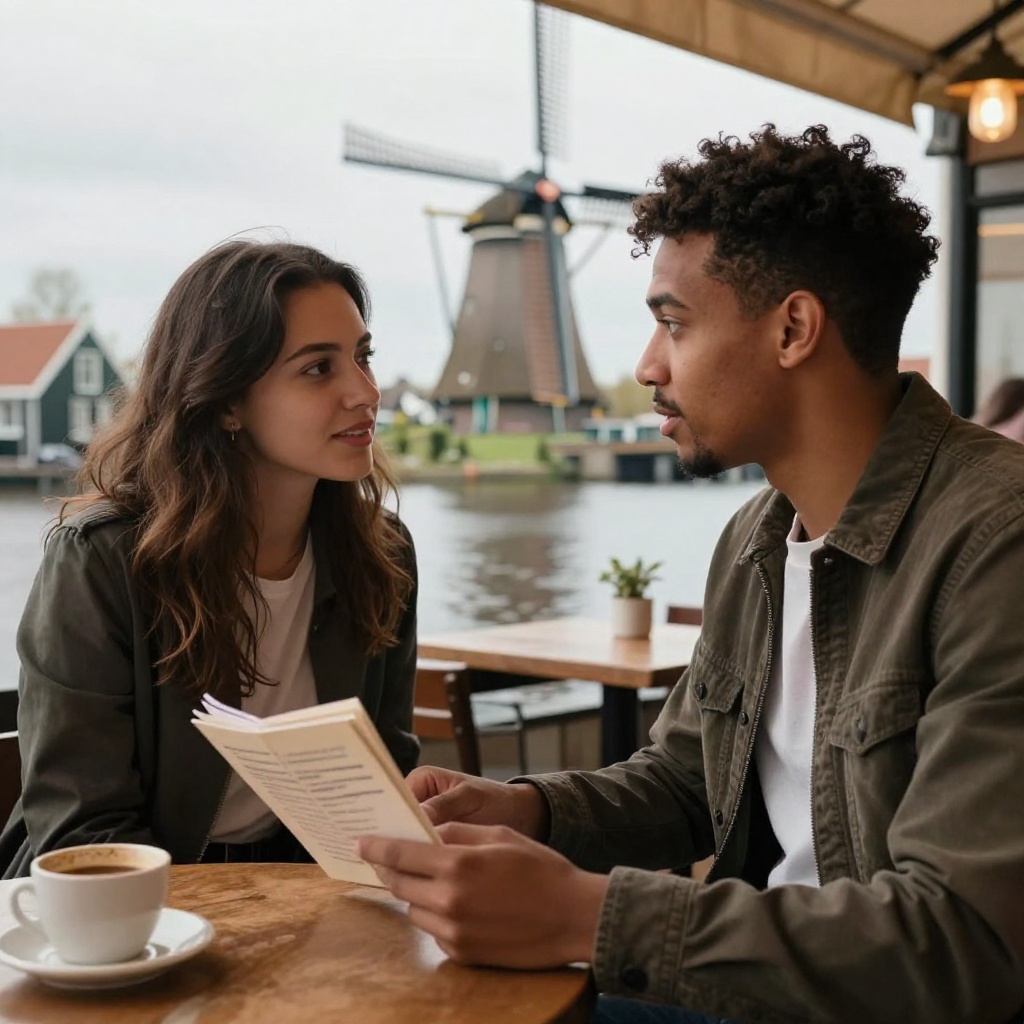
Dutch for Couples: Essential Phrases
Master Dutch with your partner. Essential phrases for daily life, romance, and family dinners. Perfect for mixed-language couples.
When you're in a relationship with a Dutch speaker, everyday communication becomes your greatest opportunity to connect. Whether you're waking up together, making plans, or sharing your feelings, having the right phrases ready makes all the difference.
This guide covers the essential Dutch phrases every couple needs, organized by the moments that matter most in your daily life together.
Morning Greetings
Phrase to Learn
Goedemorgen, lieverd
Good morning, darling
[ KHOO-duh-MOR-khun, LEE-vert ]
Start your day by greeting your partner in Dutch - it sets a loving tone for the whole day.
Starting the day in Dutch shows your partner you're thinking of them. Here are the essential morning phrases:
Pronunciation: KHOO-duh-MOR-khun, skhaht
"Goedemorgen schat, heb je lekker geslapen?"
Pronunciation: hep yuh khoot khuh-SLAH-pun
"Goedemorgen! Heb je goed geslapen?"
Pronunciation: ik hep OH-ver yuh khuh-DROHMT
"Ik heb over je gedroomd vannacht."
Pronunciation: vil yuh KOF-fee
"Wil je koffie of thee?"
Throughout the Day
These phrases keep you connected during your daily routines:
Pronunciation: hoo khaht het met yuh
"Hoi schat, hoe gaat het met je vandaag?"
Pronunciation: ik denk ahn yuh
"Ik denk aan je. Hoe is je dag?"
Pronunciation: ik mis yuh
"Ik mis je zo erg vandaag."
Pronunciation: hoo vas yuh dakh
"Hoi lieverd, hoe was je dag?"
Dutch Directness
Dutch people are famously direct in their communication. Don't be surprised if your partner asks straight questions or gives honest answers. This isn't rudeness - it's authenticity. They'll appreciate the same directness from you, especially about your feelings.
Expressing Love and Affection
The heart of couple communication - expressing how you feel:
Pronunciation: ik how van yuh
"Ik hou van je met heel mijn hart."
Pronunciation: yuh bent leef
"Dank je wel, je bent zo lief."
Pronunciation: ik ben khek op yuh
"Weet je, ik ben echt gek op je."
Pronunciation: yuh mahkt muh khuh-LUK-ikh
"Je maakt me zo ontzettend gelukkig."
Pronunciation: yuh bent mine AH-les
"Je weet dat je mijn alles bent."
Making Plans Together
Essential phrases for organizing your life as a couple:
Pronunciation: vat ZUL-un vuh doon
"Wat zullen we vanavond doen?"
Pronunciation: ZUL-un vuh owt AY-tun khahn
"Zullen we vanavond uit eten gaan?"
Pronunciation: hep yuh zin om
"Heb je zin om een film te kijken?"
Pronunciation: ik hep zin in
"Ik heb zin in een wandeling."
| Dutch | English | Use When |
|---|---|---|
| Zullen we...? | Shall we...? | Making suggestions |
| Heb je zin om...? | Do you feel like...? | Asking preferences |
| Laten we... | Let's... | Proposing activities |
| Wat denk je van...? | What do you think of...? | Getting their opinion |
Dinner and Food Conversations
Food is a big part of Dutch life. Here are phrases for meal times:
Pronunciation: vat AY-tun vuh vah-NAH-vont
"Schat, wat eten we vanavond?"
Pronunciation: zal ik KOH-kun
"Zal ik vanavond koken?"
Pronunciation: het is HARE-luk
"Dit is echt heerlijk, dank je wel!"
Pronunciation: ate SMAH-kuh-luk
"Zo, eet smakelijk!"
Dutch Meal Culture
The Dutch typically have their main warm meal in the evening (avondeten), while lunch is often simple - bread with toppings. Don't be surprised if your partner's idea of lunch is a sandwich! Also, the Dutch love their "gezelligheid" (coziness) - making meals together is about more than just food.
Giving Compliments
Make your partner feel special with these compliments:
Pronunciation: yuh zeet air MOY owt
"Wauw, je ziet er echt mooi uit vanavond."
Pronunciation: yuh bent zo knap
"Weet je dat je zo knap bent?"
Pronunciation: dat staht yuh khoot
"Die kleur staat je heel goed."
Pronunciation: ik ben trots op yuh
"Ik ben zo trots op je, schat."
Apologizing and Making Up
Even the best couples need these phrases sometimes. Het spijt me is the safest all-purpose apology, but it can feel a little general on its own. Add a reason when you want to sound more sincere: Het spijt me dat ik te laat was. (I'm sorry I was late.) When the hurt is deeper, Vergeef je me? is more emotionally direct, so save it for moments when you really want to ask for forgiveness. Het geeft niet works best for small mistakes or reassurance, while Laten we erover praten is the calm, adult phrase for keeping the conversation open instead of escalating it.
Pronunciation: het spate muh
"Het spijt me, ik had dat niet moeten zeggen."
Pronunciation: ver-KHAFE yuh muh
"Het spijt me echt. Vergeef je me?"
Pronunciation: het khayft neet
"Het geeft niet, maak je geen zorgen."
Pronunciation: LAH-tun vuh AIR-oh-ver PRAH-tun
"Laten we er rustig over praten."
Evening and Bedtime
Wind down the day together with these phrases:
Pronunciation: KHOO-duh-AH-vont, LEEF-yuh
"Goedenavond liefje, fijn dat je thuis bent."
Pronunciation: ik ben moo
"Ik ben best moe vandaag."
Pronunciation: ZUL-un vuh nahr bet khahn
"Het is laat. Zullen we naar bed gaan?"
Pronunciation: VEL-tuh-RUS-tun, skhaht
"Welterusten schat, slaap lekker."
Pronunciation: slahp LEK-er
"Slaap lekker, lieverd."
Pronunciation: drohm zakht
"Welterusten, droom zacht."
Weekend and Free Time
Pronunciation: LAH-tun vuh eets lowks doon
"Het is weekend! Laten we iets leuks doen."
Pronunciation: ZUL-un vuh un VAN-duh-ling MAH-kun
"Het is mooi weer. Zullen we een wandeling maken?"
Pronunciation: ik vil khrahkh bay yuh zine
"Ik wil gewoon graag bij je zijn vandaag."
The Verb "Houden Van" (To Love)
Since love is central to couple communication, here's how to conjugate this essential verb:
Houden van
to love
| I | ik hou(d) van | I love |
| You (informal) | jij houdt van | you love |
| He/She | hij/zij houdt van | he/she loves |
| We | wij houden van | we love |
| You (plural) | jullie houden van | you all love |
| They | zij houden van | they love |
Quick Reference: Daily Phrases
| Time | Dutch | English |
|---|---|---|
| Morning | Goedemorgen, schat | Good morning, sweetheart |
| Midday | Hoe gaat het? | How are you? |
| Afternoon | Ik denk aan je | I'm thinking of you |
| Evening | Hoe was je dag? | How was your day? |
| Night | Welterusten, slaap lekker | Goodnight, sleep well |
| Emotion | Dutch | English |
|---|---|---|
| Love | Ik hou van je | I love you |
| Missing | Ik mis je | I miss you |
| Happy | Je maakt me gelukkig | You make me happy |
| Sorry | Het spijt me | I'm sorry |
| Thanks | Dank je wel, lieverd | Thank you, darling |
Learning these everyday phrases will transform your communication with your Dutch partner. Start with a few phrases each day, and before long, Dutch will become a natural part of your relationship. Your partner will appreciate every effort you make to speak their language.
Related Articles
Ready to learn together?
Speak their language, touch their heart. Fun games, voice practice & goals made for two.
Start Learning for $0.00 →✨ Try free — no credit card needed
Frequently Asked Questions
What's a good way to say 'goodnight' in Dutch besides 'goedenacht'?
'Slaap lekker' (sleep well) is a common and affectionate way to say goodnight. It conveys a sense of caring and warmth. You can also say 'Welterusten' (rest well), which is a more formal alternative. Practice these with your partner to end the day sweetly.
How do I say 'I miss you' in Dutch?
The most common way to say 'I miss you' is 'Ik mis je.' It's a simple and direct expression of longing. You can also say 'Ik verlang naar je' (I yearn for you), which is a more intense and romantic expression. Leaving little notes around the house can surprise your partner.
Are there any phrases for comforting someone in Dutch?
'Het komt goed' (It will be alright) is a reassuring phrase to offer comfort. You can also say 'Maak je geen zorgen' (Don't worry) or 'Ik ben er voor je' (I'm here for you). Offering support in their language shows you care.
How do I say 'thank you for the food' in Dutch after a meal?
'Het was heerlijk' (It was delicious) is a great way to express your appreciation for the meal. You can also say 'Dank je wel voor het eten' (Thank you for the food). A simple and sincere thank you goes a long way. Couples can take turns cooking and expressing gratitude.
How can I practice these phrases with my partner?
Incorporate the phrases into your daily routines. Greet each other in Dutch in the morning, express your love and affection throughout the day, and use Dutch phrases during meals. Make it a fun and interactive way to learn and connect. Consistent practice is key.