Meeting Your Dutch Partner's Family: Essential Phrases and Cultural Tips
Prepare for that important first meeting with your Dutch partner's family. Learn the right phrases, cultural expectations, and how to make a great impression.
Meeting your partner's family is a milestone in any relationship, and when that family is Dutch, there are specific phrases and cultural nuances that can help you make a wonderful first impression. The Dutch value authenticity and directness, so being prepared while staying genuine is the perfect combination.
Let's get you ready for this important step in your relationship.
Phrase to Learn
Leuk om u te ontmoeten
Nice to meet you
[ lowk om oo tuh ont-MOO-tun ]
The polite, formal way to greet your partner's parents for the first time. Use 'u' (formal you) to show respect.
Family Terms You Need to Know
First, learn how to talk about family members. Understanding the hierarchy and the names for different relatives helps you follow the conversation when stories about childhood or extended family reunions come up. In the Netherlands, family structures are often close-knit but respect individual independence.
When you are introduced to the wider circle, you might notice that names for grandparents or aunts can vary slightly by region, but the standard terms provided below will be understood everywhere. It is helpful to memorize these so you can identify who is being discussed during dinner.
Immediate Family
Pronunciation: duh OW-ders
"Ik ben benieuwd om je ouders te ontmoeten."
Pronunciation: duh VAH-der / PAH-pah
"Je vader lijkt heel aardig."
Pronunciation: duh MOO-der / MAH-mah
"Je moeder is zo lief."
Pronunciation: duh broor
"Heb je een broer of zus?"
Pronunciation: duh zus
"Je zus lijkt heel erg op je!"
Extended Family
| Dutch | English | Pronunciation |
|---|---|---|
| de opa | the grandfather | duh OH-pah |
| de oma | the grandmother | duh OH-mah |
| de grootouders | the grandparents | duh KHROHT-ow-ders |
| de oom | the uncle | duh ohm |
| de tante | the aunt | duh TAN-tuh |
| de neef | the nephew/cousin (male) | duh nayf |
| de nicht | the niece/cousin (female) | duh nikht |
| de schoonouders | the in-laws (parents) | duh SKHOHN-ow-ders |
| de schoonmoeder | mother-in-law | duh SKHOHN-moo-der |
| de schoonvader | father-in-law | duh SKHOHN-vah-der |
Dutch Family Dynamics
Dutch families tend to be relatively informal and egalitarian. Children often address parents by their first names, and hierarchy is less emphasized than in many cultures. However, as a new partner meeting the family, starting more formally and letting them invite you to be casual is the best approach.
First Meeting Phrases
The initial introduction sets the tone for your entire visit. In the Netherlands, a firm handshake while looking someone in the eye is the standard way to greet adults. While the atmosphere is generally relaxed, showing a baseline of respect through your initial words demonstrates that you value the occasion and the people you are meeting.
This part of the visit often involves a brief transition period. You will likely be invited in, asked to hang up your coat, and then led to a seating area for coffee or tea. Having a few set phrases ready allows you to navigate these first five minutes with confidence while you adjust to the new environment and the sound of the language around you.
The following subsections cover the essentials for these first moments, including how to greet the parents politely and how to navigate the linguistic choice between formal and informal address.
Greeting the Parents
Pronunciation: KHOO-duh-AH-vont, lowk oo tuh ont-MOO-tun
"Goedenavond, leuk u eindelijk te ontmoeten!"
Pronunciation: ik hep al zo-VALE OH-ver oo khuh-HOORT
"Leuk u te ontmoeten, ik heb al zoveel over u gehoord."
Pronunciation: dank oo vel vor duh OWT-noh-duh-khing
"Dank u wel voor de uitnodiging, het is zo'n mooi huis."
Pronunciation: dit is vor oo
"Dit is voor u - ik hoop dat u van bloemen houdt."
Using Formal vs. Informal "You"
In Dutch, u is formal and je/jij is informal. When meeting parents for the first time:
| Situation | Use | Example |
|---|---|---|
| First meeting | u | Leuk u te ontmoeten |
| They say "zeg maar je" | je | Leuk je te zien |
| After invitation to be informal | je | Hoe gaat het met je? |
Pronunciation: zekh mahr yuh
"Oh, zeg maar je hoor!"
The 'Tutoyeren' Moment
When Dutch people invite you to use the informal "je" instead of "u," this is called "tutoyeren." They might say "zeg maar je" or "je mag me gewoon [name] noemen" (you can just call me [name]). This is a sign they're welcoming you and want you to feel comfortable. Accept graciously!
Making Conversation
Once everyone is settled with a drink, the conversation will shift toward getting to know you. Dutch culture prizes "gezelligheid," a concept that roughly translates to coziness or social togetherness. Creating this atmosphere involves active participation in the group dialogue and showing a genuine interest in the lives of your hosts.
You might find that the conversation moves quickly between lighthearted topics and more serious discussions. The Dutch are known for their curiosity about other cultures and lifestyles, so expect questions that go beyond surface-level pleasantries. They appreciate honesty and aren't afraid of a little debate, provided it remains respectful and friendly.
In the sections below, we will explore starters for small talk, ways to discuss your relationship with your partner, and how to describe your own background and career in Dutch.
Small Talk Starters
Pronunciation: vat un moy hows hayft oo
"Wat een mooi huis heeft u! Hoe lang woont u hier al?"
Pronunciation: [NAHM] hayft muh zo-VALE OH-ver oo ver-TELT
"Emma heeft me zoveel over u verteld. Ik ben blij u te leren kennen."
Pronunciation: hoo hayft oo el-KAHR ont-MOOT
"Ik ben benieuwd, hoe heeft u elkaar ontmoet?"
Pronunciation: duh town zeet air PRAKH-tukh owt
"De tuin ziet er prachtig uit. Doet u dat zelf?"
Talking About Your Relationship
Pronunciation: vuh HEB-un el-KAHR ont-MOOT in
"We hebben elkaar ontmoet in Amsterdam, op het werk."
Pronunciation: vuh zine noo [TITE] SAH-mun
"We zijn nu een jaar samen."
Pronunciation: ik how hale vale van oov zohn/DOKH-ter
"Ik hou heel veel van uw dochter. Ze is heel bijzonder."
Answering Questions About Yourself
Parents will ask about you. Be prepared:
Pronunciation: ik kom owt
"Ik kom uit Engeland, maar ik woon nu in Nederland."
Pronunciation: ik werk als
"Ik werk als software ontwikkelaar."
Pronunciation: ik ben [buh-ROOP]
"Ik ben docent Engels."
Pronunciation: ik lare NAY-der-lants
"Ik leer Nederlands omdat ik hier wil blijven."
At the Dinner Table
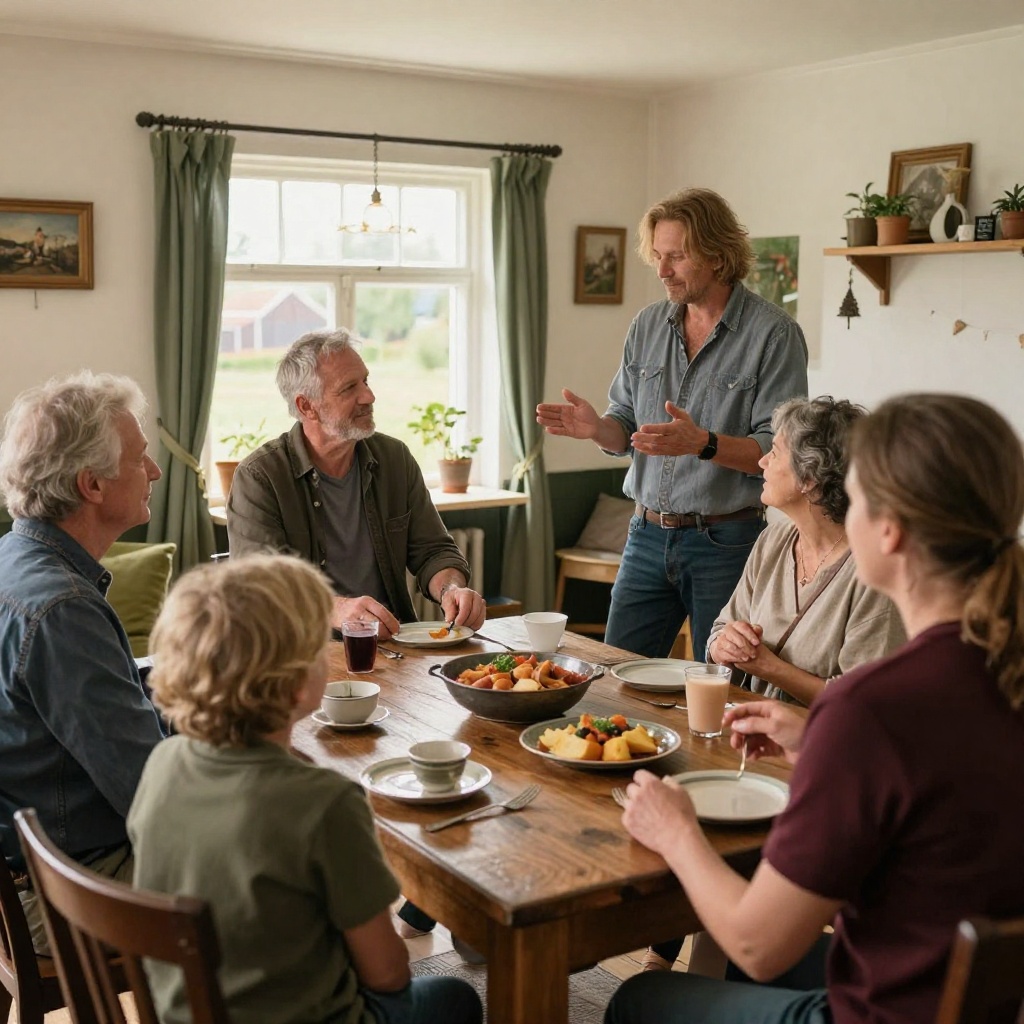
Dutch families often bond over meals, which are seen as the primary time for "bijpraten" (catching up). Unlike some cultures where the meal is a formal affair, a Dutch dinner is often a practical and communal experience where everyone contributes to the flow of conversation.
Paying attention to table manners is important, but being an enthusiastic eater is even better. Complimenting the food and showing that you are enjoying the "gezelligheid" of the meal will go a long way in making you feel like a part of the family.
Table Phrases
Pronunciation: ate SMAH-kuh-luk
"Zo, eet smakelijk allemaal!"
Pronunciation: het zeet air HARE-luk owt
"Wauw, het ziet er heerlijk uit!"
Pronunciation: dit is hale erkh LEK-er
"Dit is heel erg lekker. Heeft u het zelf gemaakt?"
Pronunciation: makh ik het ruh-SEPT
"Dit is zo lekker! Mag ik het recept?"
Offering and Accepting
| Dutch | English | When to Use |
|---|---|---|
| Ja, graag | Yes, please | Accepting offers |
| Nee, dank u | No, thank you | Politely declining |
| Nog een beetje | A little more | Second helping |
| Ik zit vol | I'm full | Declining more food |
Pronunciation: makh ik nokh vat
"Dit is zo lekker, mag ik nog wat?"
Pronunciation: nay dank oo, ik zit vol
"Nee dank u, ik zit vol. Het was heerlijk."
Dutch Directness About Food
Dutch hosts are usually direct and won't push food on you excessively. If you say you're full, they'll accept it. Unlike some cultures where you must decline multiple times, in the Netherlands a simple "nee dank u" is respected. Conversely, if you want more, just ask - they appreciate directness!
Making a Good Impression
Beyond what you say, how you act in a Dutch home speaks volumes. There is a strong cultural emphasis on being "gewoon" (normal or down-to-earth). Making a good impression isn't about being flashy or overly formal; it's about being a considerate guest who pays attention to the small details of the household environment.
Showing up on time is the first step, as punctuality is highly valued in the Netherlands and being late is often seen as disrespectful. once inside, being proactive—whether that's through a thoughtful gift or a simple offer to clear a plate—signals that you are happy to be part of the family circle rather than just an observer.
In the following sections, we will cover the etiquette of gift-giving and how to offer your help around the house to show your appreciation for the hospitality.
Bringing Gifts
In Dutch culture, bringing a small gift when visiting is appreciated:
Pronunciation: ik hep BLOOM-un vor oo MAY-khuh-brakht
"Hier, ik heb bloemen voor u meegebracht."
Pronunciation: dit is un KLINE-ukh-hate-yuh
"Dit is maar een kleinigheidje voor u."
Good gift ideas:
- Flowers (bloemen) - always appreciated
- Chocolates (chocolade)
- A nice bottle of wine (een goede fles wijn)
- Something from your home country
Offering to Help
Pronunciation: kan ik ERK-huns may HEL-pun
"Kan ik ergens mee helpen in de keuken?"
Pronunciation: zal ik duh TAH-ful DEK-un
"Zal ik de tafel dekken?"
Pronunciation: zal ik AF-row-mun
"Zal ik afruimen? Het was echt lekker."
Saying Goodbye
Ending a visit in a Dutch household is rarely a rushed affair. Often, there is a clear "afsluiting" or closing period where the last round of coffee is finished and plans for the future are discussed. Leaving gracefully is just as significant as arriving politely, as it cements the positive feelings built during the visit.
The phrases you use during departure should reflect the time you spent together. It is common to express gratitude not just for the food or drinks, but for the "gezelligheid" of the entire experience. Taking a moment to say goodbye to each person individually shows that you have valued their company.
Below are the key phrases to use as you prepare to leave, helping you wrap up the evening on a high note and ensure a second invitation in the future.
End of Visit Phrases
Pronunciation: buh-DANKT vor duh khuh-ZEL-uh-khuh AH-vont
"Bedankt voor de gezellige avond. Het was heel fijn."
Pronunciation: het vas hale lowk om KEN-nis tuh MAH-kun
"Het was heel leuk om kennis te maken met u."
Pronunciation: ik hohp dat vuh el-KAHR snel ware zeen
"Ik hoop dat we elkaar snel weer zien!"
Pronunciation: oo bent AL-tite VEL-kom bay ons
"U bent ook altijd welkom bij ons."
The Three Kisses
When saying goodbye (and sometimes hello) to family members, Dutch people often exchange three kisses on alternating cheeks (right-left-right). This is called "drie zoenen." Don't be surprised if your partner's family welcomes you this way - it's a sign of acceptance! If you're unsure, follow your partner's lead.
Handling Awkward Moments
Even with the best preparation, there might be moments where the language barrier feels a bit high or a cultural nuance is missed. The Dutch are generally forgiving of language learners and deeply appreciate the vulnerability required to speak a new language. Acknowledging a misunderstanding directly is usually the quickest way to move past it.
If the conversation moves into fast-paced Dutch that you can't follow, it is perfectly acceptable to ask for a brief pause or a translation. Using specific phrases to signal your confusion prevents you from feeling left out and allows the family to support your learning process. Honesty about your language level is always better than nodding along without understanding.
The following sections will give you the tools to handle language gaps and minor errors with grace, keeping the atmosphere light and friendly even when things don't go perfectly.
If You Don't Understand
Pronunciation: SOR-ry, kunt oo dat her-HAH-lun
"Sorry, kunt u dat herhalen? Ik leer nog Nederlands."
Pronunciation: ik buh-KRIPE het neet HAY-luh-mahl
"Sorry, ik begrijp het niet helemaal. Kunt u langzamer spreken?"
Pronunciation: hoo zekh yuh dat in het NAY-der-lants
"Hoe zeg je 'kitchen' in het Nederlands?"
If You Make a Mistake
Pronunciation: SOR-ry, mine NAY-der-lants is nokh neet per-FEKT
"Ha, sorry, mijn Nederlands is nog niet perfect!"
Pronunciation: ik doo mine best
"Ik doe mijn best om Nederlands te leren."
Key Verbs for Family Conversations
Ontmoeten
to meet
| I | ik ontmoet | I meet |
| You (informal) | jij ontmoet | you meet |
| You (formal) | u ontmoet | you meet |
| He/She | hij/zij ontmoet | he/she meets |
| We | wij ontmoeten | we meet |
| They | zij ontmoeten | they meet |
Quick Reference: First Meeting Checklist
| Situation | What to Say |
|---|---|
| Greeting | Goedenavond, leuk u te ontmoeten |
| Giving a gift | Dit is voor u |
| Complimenting | Wat een mooi huis heeft u |
| At dinner | Eet smakelijk / Het is heerlijk |
| Offering help | Kan ik ergens mee helpen? |
| Goodbye | Bedankt voor de gezellige avond |
| Future plans | Ik hoop u snel weer te zien |
Cultural Tips Summary
- Start formal - Use "u" until invited to use "je"
- Bring a gift - Flowers or chocolates are always safe choices
- Be genuine - Dutch people value authenticity over excessive politeness
- Show interest - Ask questions about them and their home
- Offer to help - But accept if they decline
- Be direct - Don't over-apologize or be overly modest
- Enjoy the moment - Dutch families appreciate someone who can relax and be themselves
Meeting your Dutch partner's family is an exciting step. The fact that you're learning their language shows respect and commitment. Don't worry about being perfect - your effort will be appreciated, and most Dutch families are warm and welcoming. Focus on being yourself, use these phrases when you can, and enjoy getting to know the people who raised the person you love.
Related Articles
Ready to learn together?
Speak their language, touch their heart. Fun games, voice practice & goals made for two.
Start Learning for $0.00 →✨ Try free — no credit card needed
Frequently Asked Questions
What are some appropriate topics to avoid during the first meeting with my Dutch partner's family?
Avoid discussing sensitive topics like politics, religion, or personal finances unless they bring it up first. Steer clear of complaining about your partner or their family. Focus on positive and neutral subjects like hobbies, travel, or current events. Prepare some conversation starters in advance with your partner.
If I accidentally use the formal 'u' when I should have used 'je/jij,' how can I correct myself?
Simply say, "Mag ik 'je' zeggen?" (May I say 'je'?). It's a polite way to ask if you can switch to the informal form. Most people will appreciate your consideration and grant you permission. Don't dwell on the mistake; just move on with the conversation. Discuss common faux pas with your partner beforehand.
What kind of gift is most appreciated when meeting a Dutch family for the first time?
Flowers are always a safe bet, but avoid chrysanthemums, as they are associated with funerals. A small, thoughtful gift related to your home country or a local delicacy is also a good option. Avoid bringing overly expensive or extravagant gifts, as this can make people uncomfortable. Your partner can offer specific suggestions.
How can I handle it if I don't understand something that's being said during the conversation?
Don't pretend to understand. Politely ask them to repeat themselves or explain it in simpler terms. You can say, "Sorry, ik begrijp het niet helemaal. Kunt u dat alstublieft herhalen?" (Sorry, I don't quite understand. Could you please repeat that?). It's better to be honest than to nod along and miss important information. Practicing basic phrases with your partner will help.
Besides speaking Dutch, what are some other ways to show respect to my partner's family?
Be punctual, dress appropriately, and offer to help with tasks like setting the table or doing the dishes. Listen attentively when others are speaking and show genuine interest in what they have to say. Be polite and respectful to everyone, regardless of their age or status. Talk to your partner about their family's specific expectations.