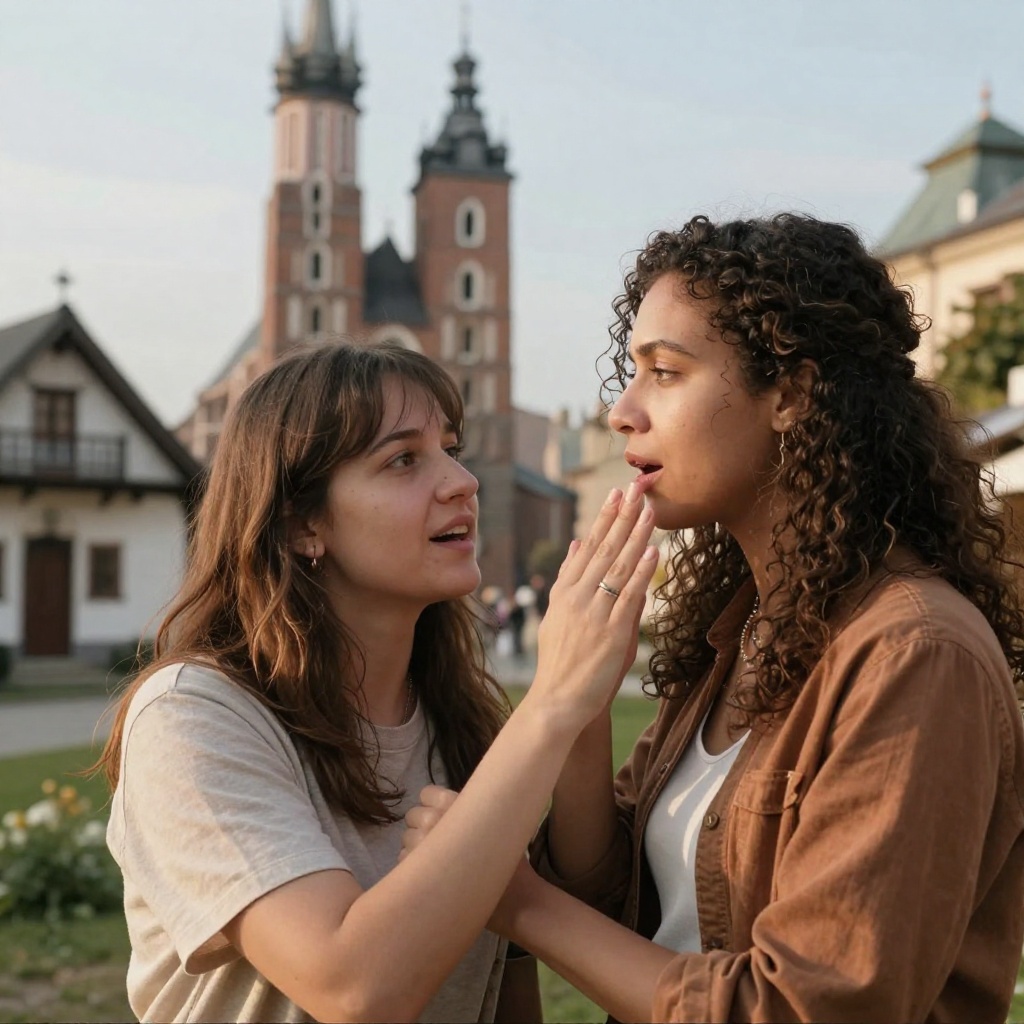
Polish Past Tense: Talk About Your Day
Master Polish past tense conjugations with our couple-friendly guide. Learn to share your daily experiences with your Polish-speaking partner confidently.
Sharing your day with your partner is one of the most useful ways to practice Polish. In this article, you will learn the czas przeszły through real phrases you can say about meals, work, errands, and evening plans. Every example pairs Polish with English so you can see exactly how the past tense changes by gender and context.
Phrase to Learn
Co robiłeś dzisiaj?
What did you do today?
[ tso ro-BEE-wesh JEE-shay ]
The perfect question to start sharing about your day together.
How Polish Past Tense Works
Unlike English, Polish past tense changes based on both the person doing the action and the speaker's gender. That means robiłem and robiłam both mean "I did," but they are used by different speakers.
The basic pattern is:
Verb stem + -ł/-ła/-ło + personal ending
Gender Matters
Use -łem if you are a man: jadłem obiad = "I ate lunch." Use -łam if you are a woman: jadłam obiad = "I ate lunch." The same logic applies to -łeś/-łaś for "you."
Choose the form by the speaker, not by the person you are talking to.
Essential Daily Verbs in Past Tense
Let's start with the most common verbs you'll use when sharing your day:
Robić
to do, make
| Form | Polish | Use it when... |
|---|---|---|
| I (masc.) | robiłem | you are a man speaking about yourself: Wczoraj robiłem zakupy. = "Yesterday I did the shopping." |
| I (fem.) | robiłam | you are a woman speaking about yourself: Wczoraj robiłam zakupy. = "Yesterday I did the shopping." |
| You (masc.) | robiłeś | you are talking to a man: Co robiłeś po pracy? = "What did you do after work?" |
| You (fem.) | robiłaś | you are talking to a woman: Co robiłaś po pracy? = "What did you do after work?" |
| He | robił | the subject is male: On robił kolację. = "He was making dinner." |
| She | robiła | the subject is female: Ona robiła kolację. = "She was making dinner." |
Pronunciation: JEE-shay ro-BEE-wam za-KOO-pi
"Dzisiaj robiłam zakupy w centrum miasta."
More Essential Daily Verbs
| Infinitive | Meaning | Example sentence | Why choose it? |
|---|---|---|---|
| jeść | to eat | Jadłem śniadanie o ósmej. / Jadłam śniadanie o ósmej. | Use for meals and food in the past. |
| pić | to drink | Piłem kawę w pracy. / Piłam kawę w pracy. | Use when talking about drinks, coffee, tea, water. |
| pracować | to work | Pracowałem do późna. / Pracowałam do późna. | Use for jobs, study sessions, and busy days. |
| spotkać | to meet | Spotkałem się z przyjacielem. / Spotkałam się z przyjaciółką. | Use for one-time meetings or meetings you completed. |
| oglądać | to watch | Oglądałem film wieczorem. / Oglądałam film wieczorem. | Use for an action you were doing or repeated watching. |
Tip: when you want a finished action, choose a perfective pair such as zjeść, wypić, przepracować, or spotkać; when you want an activity in progress, use the imperfective form.
Common Daily Conversation Starters
Use these openers when you want to move from small talk into a real Polish conversation about your day:
Pronunciation: MYA-wem TROOD-ni jehn
"Miałem trudny dzień w pracy, kochanie."
- Wczoraj spotkałem koleżankę po pracy. (Yesterday I met a female friend after work.) - FCHO-ray spot-KA-wem ko-leh-ZHAHN-keh po PRA-tsi
- Rano jadłam spokojne śniadanie w domu. (In the morning I ate a calm breakfast at home.) - RA-no YAD-wam spo-KOY-neh shnya-DA-nyeh v DO-mu
- Po pracy poszedłem na spacer. (After work I went for a walk.) - po PRA-tsi po-SHE-dwem na SPA-tser
- Wieczorem oglądaliśmy film i rozmawialiśmy. (In the evening we watched a film and talked.) - vye-CHO-rem og-lon-DA-lee-shmi felem ee roz-ma-VYA-lee-shmi
Try replacing the last part with your own activity: jadłam kolację, spotkałem przyjaciela, czytałam książkę, or odpoczywałem.
Telling Stories: Past Tense in Action
Let's see how these work in real conversations between partners:
Scenario 1: Sharing a good day
- Kochanie, świetnie się dzisiaj bawiłam! (Darling, I had a great time today!) - ko-HA-nyeh shvyet-NYeh sheh JEE-shay ba-VEE-wam
- Spotkałam się z Anią na kawie (I met with Ania for coffee) - spot-KA-wam sheh z A-nyon na KA-vyeh
- Potem poszłyśmy na zakupy (Then we went shopping) - PO-tem posh-WI-shmi na za-KOO-pi
Scenario 2: A challenging day
- Dzisiaj miałem stresujący dzień (Today I had a stressful day) - JEE-shay MYA-wem stre-su-YON-tsi jehn
- Szef dał mi dużo dodatkowej pracy (The boss gave me a lot of extra work) - shef daw mee DOO-zho do-dat-KO-vey PRA-tsi
- Wróciłem późno do domu (I came home late) - VROO-chee-wem POOZH-no do DO-mu
Polish Storytelling Style
Poles often use more descriptive language when sharing experiences. Don't just say "I worked" - try "pracowałem ciężko" (I worked hard) or "miałem dużo roboty" (I had a lot of work).
Time Expressions for Daily Stories
These time words will make your stories flow naturally:
- Rano (in the morning) - RA-no
- W południe (at noon) - f po-WOO-dnyeh
- Po południu (in the afternoon) - po po-WOO-dnyou
- Wieczorem (in the evening) - vye-CHO-rem
- Przed snem (before sleep) - pshed snem
- Cały dzień (all day) - TSA-wi jehn
Advanced: Perfect vs. Imperfect Aspect
Polish has two types of past tense actions:
Completed actions (perfective):
- Przeczytałem książkę (I read/finished reading the book) - pshe-chi-TA-wem kshyONZH-keh
- Zjadłam obiad (I ate/finished eating lunch) - ZYA-dwam O-byat
Ongoing/repeated actions (imperfective):
- Czytałem książkę (I was reading the book) - chi-TA-wem kshyONZH-keh
- Jadłam obiad (I was eating lunch) - YAD-wam O-byat
Pro tip: When telling your partner about your day, use perfective verbs for completed activities and imperfective for things you were doing or used to do regularly.
Practice Conversations
Partner A: Co robiłaś po pracy? (What did you do after work?) - tso ro-BEE-wash po PRA-tsi
Partner B: Poszłam na siłownię, a potem gotowałam kolację. (I went to the gym, and then I cooked dinner.) - posh-WAM na shee-WOV-nyeh a PO-tem go-to-VA-wam ko-LA-tsyeh
Partner A: Świetnie! Ja oglądałem film i czytałem książkę. (Great! I watched a movie and read a book.) - shvyet-NYeh ya og-lon-DA-wem feelm ee chi-TA-wem kshyonZH-keh
Partner B: A potem jak się czułaś? (And how did you feel after that?) - a PO-tem yak shyeh CHOO-wash
Common Mistakes to Avoid
- Forgetting gender agreement - Match the ending to the speaker: robiłem for a male speaker, robiłam for a female speaker.
- Using present tense accidentally - Pracuję means "I work," but pracowałem/pracowałam means "I worked."
- Choosing the wrong aspect - Use perfective for finished events like zjadłem obiad; use imperfective for actions in progress like jadłem obiad.
If you are unsure, start with one finished action and one ongoing action in the same conversation. That gives you a natural contrast.
Pronunciation: yak mee-NONW chee jehn
"Cześć skarbie, jak minął ci dzień?"
Your Daily Practice
Start tonight by asking your partner "Jak minął ci dzień?" (How was your day?) and answering with three short sentences. Use this pattern:
- One finished action: Zjadłem obiad. / Zjadłam obiad. = "I ate lunch."
- One interaction: Spotkałem się z przyjacielem. / Spotkałam się z przyjaciółką. = "I met a friend."
- One longer activity: Oglądałem film. / Oglądałam film. = "I was watching a movie."
If you want more challenge, add a time word like rano, po pracy, or wieczorem: Wieczorem oglądałam film i jadłam kolację.
With a few repeated conversations, you will quickly sound more natural when talking about everyday life in Polish.
Ready to learn together?
Speak their language, touch their heart. Fun games, voice practice & goals made for two.
Start Learning for $0.00 →✨ Try free — no credit card needed
Frequently Asked Questions
How do I form a simple sentence in Polish past tense about eating breakfast?
To say 'I ate breakfast' in Polish, you would say "Zjadłem śniadanie" (if you are male) or "Zjadłam śniadanie" (if you are female). The verb 'jeść' (to eat) becomes 'zjadłem/zjadłam' in the past tense. Couples can practice conjugating common verbs like this and then asking each other what they ate for breakfast.
What's the difference between 'robiłem' and 'zrobiłem' when talking about doing something?
The difference lies in the aspect: 'robiłem' is imperfective, meaning you were in the process of doing something (e.g., 'Robiłem obiad' - I was making dinner). 'Zrobiłem' is perfective, meaning you completed the action (e.g., 'Zrobiłem obiad' - I made dinner). Couples can quiz each other on the correct aspect to use in different scenarios while cooking together.
How do I talk about what I 'used to do' in Polish past tense?
To talk about habitual actions in the past, use the imperfective aspect. For example, 'Kiedyś często chodziłem do kina' (I used to often go to the cinema). You can also use 'zwykle' (usually) to indicate a past habit. As a couple, share stories about what you 'used to do' before you met, using the correct imperfective forms.
What are some common mistakes to avoid when using Polish past tense as a couple?
One common mistake is forgetting to change the verb ending based on gender. Remember, men use '-łem' and women use '-łam'. Another is confusing perfective and imperfective aspects. Practicing together and correcting each other gently can help avoid these errors.
How can my partner and I practice Polish past tense while discussing our day?
At the end of the day, each partner can describe their activities using Polish past tense. Focus on using a variety of verbs and paying attention to the correct gender endings. For example, "Poszedłem do pracy" (I went to work - male) or "Czytałam książkę" (I read a book - female).