Romanian First Date Phrases for English Speakers
Romanian phrases for a first date with pronunciation: greetings, compliments, questions, and when to use tu or dumneavoastră. Written for English speakers.
Romanian phrases for a first date work best when they are short, sincere, and said with a smile. Your date will mostly notice warmth, not grammar, so this guide focuses on the lines that do the most work, each with a pronunciation guide using English sounds. It also covers the main trap for English speakers: choosing between tu and dumneavoastră.
Making a Great First Impression
Warmth usually matters more than polish. A specific, honest compliment lands better than an extravagant one, and a simple greeting said with eye contact does more than a long speech.
The classic greeting is "Încântat de cunoștință", which literally means "enchanted by the acquaintance." It is a warm way to say "pleased to meet you." Say Încântat if you are a man and Încântată if you are a woman, because the ending agrees with the speaker. "Îmi pare bine de cunoștință" is a common, more neutral alternative.
Pronunciation: un-kuhn-TAHT / un-kuhn-TAH-tuh
"Încântat să te cunosc. (Nice to meet you.)"
A handshake is the safe default for a first meeting. Cheek kisses are more common once people know each other or feel comfortable, so let your date set that pace.
Once you see your date, "Arăți foarte bine" (ah-RUHTS FWAR-teh BEE-neh, "you look very good") is a warm, safe opener.
Compliments should be specific. Instead of only saying "Ești frumoasă" (you are beautiful, to a woman) or "Ești chipeș" (you are handsome, to a man), try "Îmi place părul tău" (I like your hair) or "Ai un zâmbet minunat" (you have a wonderful smile). Notice something real, such as an outfit choice, a piece of jewelry, or their laugh, and say so.
Pronunciation: ZUHM-bet
"Ai cel mai frumos zâmbet. (You have the most beautiful smile.)"
If your date arrives in a distinctive scarf, try "Îmi place eșarfa ta, te face să arăți foarte elegant" (I like your scarf, it makes you look very elegant; to a woman, say elegantă). It gives them an easy story to tell about where it came from. Window shopping after coffee gives you natural things to talk about too.
Pronunciation: druh-GOOTS / druh-GOO-tsuh
"Ești drăguță când râzi. (You are lovely when you laugh.)"
Tu or Dumneavoastră: How to Address Your Date
Romanian has two ways to say "you." Tu is informal and singular. Dumneavoastră (often written dvs.) is formal and takes plural verb forms, so you say vorbiți rather than vorbești. English has only one word for "you," which is why this is the main trap for English speakers.
Between people of a similar age on a date, tu is normal, often from the very first message. Start with dumneavoastră if your date is clearly older than you or the setting is formal, and let them offer the switch to tu rather than taking it yourself. If you want to suggest it yourself, ask "Putem să ne tutuim?" (poo-TEM suh neh too-too-EEM, "Can we use tu with each other?").
| In English | Informal (tu) | Formal (dumneavoastră) |
|---|---|---|
| Are you from Cluj? | Ești din Cluj? (yesht deen KLOOZH) | Sunteți din Cluj? (SOON-tets deen KLOOZH) |
| Do you speak English? | Vorbești engleză? (vor-BESHT ehn-GLEH-zuh) | Vorbiți engleză? (vor-BEETS ehn-GLEH-zuh) |
| What do you like? | Ce îți place? (cheh uhts PLA-cheh) | Ce vă place? (cheh vuh PLA-cheh) |
| Can I call you? | Pot să te sun? (pot suh teh soon) | Pot să vă sun? (pot suh vuh soon) |
| I feel good with you | Mă simt bine cu tine. | Mă simt bine cu dumneavoastră. |
Getting to Know Each Other
Good first-date conversation is about real curiosity, so have a few genuine questions ready:
- Ce îți place să faci în timpul liber? (What do you like to do in your free time?) cheh uhts PLA-cheh suh FAHCH uhn TEEM-pool LEE-ber
- De unde ești? (Where are you from?) deh OON-deh YESHT
- Ce muzică asculți? (What music do you listen to?) cheh MOO-zee-kuh ah-SKOOLTS
To talk about yourself, use "Îmi place" (uhm PLA-cheh, "I like") with a singular noun or a verb: "Îmi place să călătoresc" (I like to travel). Use "Îmi plac" (PLAHK) with a plural noun: "Îmi plac filmele" (I like movies). Mie îmi place adds emphasis, as in "as for me, I like."
Expressing Interest
If the date is going well, let them know. Romanians value directness paired with warmth, and these lines do both:
- Mă bucur că ne-am întâlnit. (I'm glad we met.) muh BOO-koor kuh nyahm un-tuhl-NEET
- Îmi place mult cum gândești. (I really like how you think.) uhm PLA-cheh moolt koom guhn-DESHT
Phrase to Learn
Petrec o seară minunată cu tine.
I'm having a wonderful evening with you.
[ peh-TREK oh SYAH-ruh mee-noo-NAH-tuh koo TEE-neh ]
Works well over dessert or as the evening winds down. In a formal setting, swap cu tine for cu dumneavoastră.
During the Date
A few easy phrases go a long way with food and atmosphere:
- E delicios! (It's delicious!) yeh deh-lee-CHOS
- Ce loc frumos! (What a lovely place!) cheh lok froo-MOS
- Noroc! (Cheers!) noh-ROK. Sănătate! (suh-nuh-TAH-teh) is another toast.
- Mă simt foarte bine cu tine. (I feel very comfortable with you.) muh seemt FWAR-teh BEE-neh koo TEE-neh
Watch Out for False Friends
Some Romanian words look like English words but mean something else. These come up often in dating conversation:
| Romanian word | Looks like | Actually means |
|---|---|---|
| eventual | eventually | possibly, maybe |
| actual | actually | current (for "actually," say de fapt) |
| sensibil | sensible | sensitive |
So if you ask "Vrei să ne vedem?" (Do you want to see each other?) and your date says "Eventual," they mean "maybe," not "eventually."
Ending the Date
If you want a second date, say so clearly. A warm, direct line is easier to answer than a vague one:
- Aș vrea să ne vedem din nou. (I'd love to see you again.) ash VRYAH suh neh veh-DEM deen noh
- Pot să te sun? (Can I call you?) pot suh teh soon
- A fost o seară grozavă. (It was a great evening.) ah fost oh SYAH-ruh groh-ZAH-vuh
Cultural Considerations
Flowers
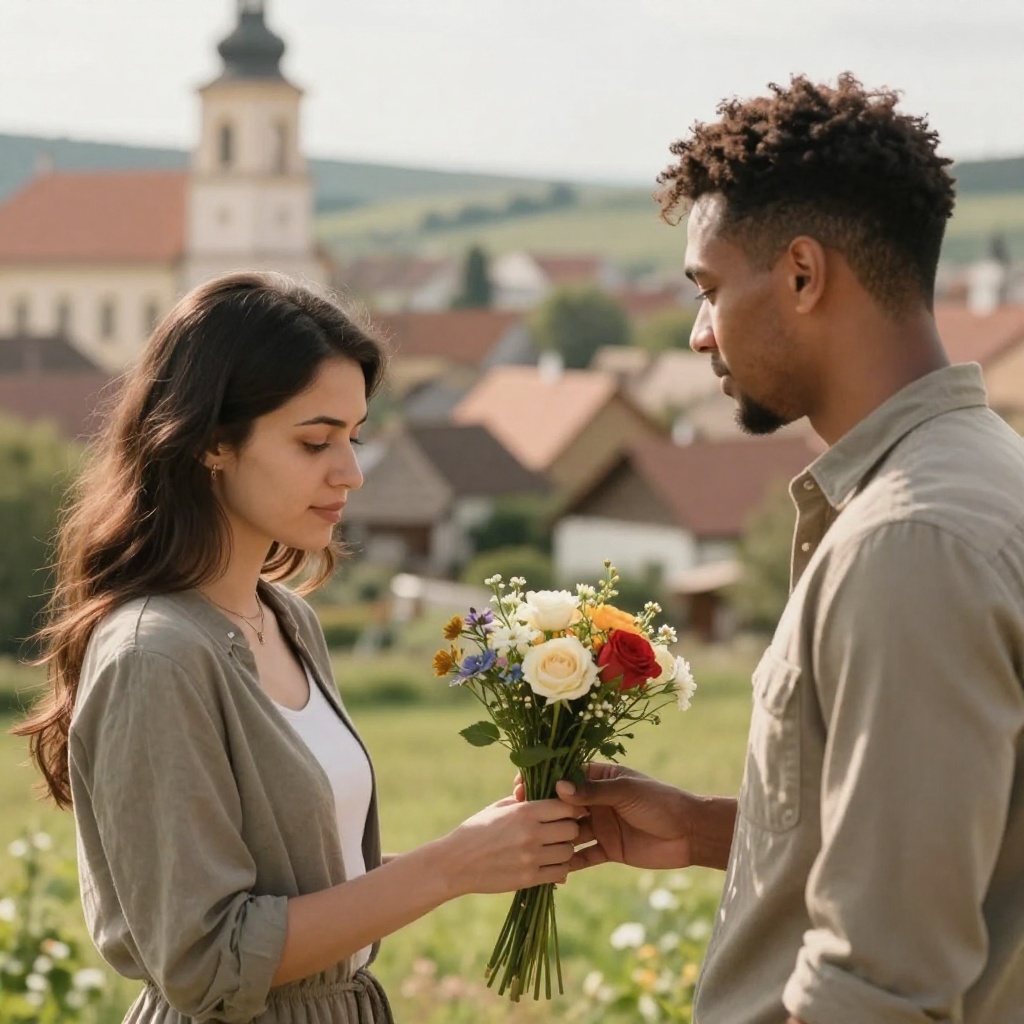
Flowers are a welcome gesture for a first date. Many Romanians prefer an odd number of stems, because even numbers are traditionally associated with funerals. Keep it modest.
Who pays
Customs differ by generation, city and family, so don't assume either way. Offer to pay, and if they want to split, accept that gracefully. The offer matters as much as the outcome.
English may come up
Many younger Romanians speak English well. If your date switches to English when your Romanian runs out, that is generous, not a sign you failed. Keep going in Romanian for a few lines first, then accept the switch.
Be on time, which is the safe default. Hold off on very personal questions, such as about past relationships or money, until trust builds.
Making the Effort
A few Romanian phrases said with a smile signal respect and curiosity. Perfect pronunciation is not the goal. Trying, and listening closely to the reply, is what your date will remember.
A Sample First-Date Conversation
Here is how the phrases from this page fit together in a real exchange. Tom is learning Romanian and Ioana is his date. Because they are about the same age, they use tu from the start. New words have a pronunciation guide.
- Tom: Bună! Sunt Tom. (Hi! I'm Tom.) BOO-nuh, soont TOM
- Ioana: Bună, Tom! Eu sunt Ioana. Încântată de cunoștință. (Hi, Tom! I'm Ioana. Pleased to meet you.)
- Tom: Încântat! Arăți foarte bine. (Pleased to meet you! You look very good.)
- Ioana: Mulțumesc! De unde ești? (Thank you! Where are you from?) mool-tsoo-MESK
- Tom: Sunt din Manchester. Dar tu? (I'm from Manchester. And you?) dar TOO
- Ioana: Din Cluj. Ce îți place să faci în timpul liber? (From Cluj. What do you like to do in your free time?)
- Tom: Îmi place să călătoresc. Și îmi plac filmele. (I like to travel. And I like movies.) shee
The food arrives.
- Tom: E delicios! Noroc! (It's delicious! Cheers!)
- Ioana: Noroc!
At the end of the evening.
- Tom: A fost o seară grozavă. Aș vrea să ne vedem din nou. (It was a great evening. I'd love to see you again.)
- Ioana: Și eu. (Me too.) shee YEH-oo
- Tom: Pot să te sun? (Can I call you?)
- Ioana: Sigur! (Sure!) SEE-goor
Notice that Tom says Încântat and Ioana says Încântată: each ending matches the speaker.
Common Mistakes English Speakers Make
Saying "Sunt 30 de ani" for your age
In English you are 30, but in Romanian you have 30 years: "Am 30 de ani" (ahm TRAY-zech deh AHN). "Sunt 30 de ani" sounds wrong to a Romanian ear. To ask someone's age, say "Câți ani ai?" (kuhts AHN eye).
Saying "Îmi place tu" for "I like you"
With a plăcea (to like), the person or thing you like is the subject, so the verb changes to match "you": "Îmi placi". Translating English word order and keeping place with tu doesn't work.
Pronunciation: uhm PLAHCH
"Îmi placi foarte mult. (I like you a lot.)"
Reading ce, ci, che and chi the English way
In Romanian, c before e or i sounds like the "ch" in "church", so ce is cheh, not "seh". Adding an h makes it hard again: chipeș is KEE-pesh, not "chip-esh". G works the same way: ge/gi sound like the "j" in "jet", and ghe/ghi like the "g" in "get".
Saying a final ă like a full "a"
The final ă is a short, relaxed "uh". If you pronounce it as a full "ah", you can change the word: o seară (oh SYAH-ruh) is "an evening", but seara (SYAH-rah) means "the evening" or "in the evening". Keep it short in frumoasă, grozavă and minunată.
Putting eu in front of every sentence
Romanian verb endings already show who is speaking, so "Sunt din Londra" sounds more natural than "Eu sunt din Londra" every time. Keep eu for contrast, as Ioana does above when it is her turn to introduce herself. Never combine eu with îmi place: "Eu îmi place" is wrong. Say Îmi place or, for emphasis, Mie îmi place.
A 5-Minute First-Date Rehearsal
Set a timer and play out a compressed first date. The Romanian-speaking partner plays the date, and the learner tries to stay in Romanian the whole time.
- Minute 1: Arrival. The learner greets with Încântat / Încântată and gives one specific compliment that starts with Îmi place... or Ai un....
- Minutes 2–3: Questions. The date asks the three questions from "Getting to Know Each Other." The learner answers each one with a short sentence (Sunt din..., Îmi place... or Îmi plac...) plus one detail, then turns it around with Dar tu?
- Minute 4: The formal switch. The date now plays someone clearly older. The learner asks two questions from the table using the dumneavoastră column, such as Sunteți din Cluj? and Vorbiți engleză?
- Minute 5: Goodbye. The learner uses all three closing lines. The date answers Sigur! or Eventual, and the learner has to react to the real meaning.
Save corrections for the end, then pick just one mistake to fix in the next round and swap who starts.
Practice It Together
Today, at your next meal together, act out the last few minutes of a first date: the learner says "E delicios!", raises a glass with "Noroc!", and ends with "A fost o seară grozavă. Aș vrea să ne vedem din nou." The partner replies only in Romanian.
Love in more than one language? Love Languages helps couples grow closer through each other's language, with fun games, conversation coaching and 114 languages for every kind of international romance.
Related Articles
Love Languages
Start learning together
Practice with your partner, celebrate progress together, and turn today's lesson into something you share.
Start together7 days free · Cancel anytime
Frequently Asked Questions
How do I say "I like you" in Romanian on a first date?
Say "Îmi placi" (uhm PLAHCH). The person you like is the grammatical subject, so the verb ends in -i to match "you". "Îmi place tu" is a common English-speaker error. For something warmer but still short of love, try "Țin la tine" (tsin lah TEE-neh, "I care about you"). "Te iubesc" (I love you) is usually kept for much later.
How do I respond when my date compliments me in Romanian?
A simple "Mulțumesc!" (mool-tsoo-MESK) or the casual "Mersi!" (MEHR-see) works. To return the compliment, add "Și tu arăți foarte bine" (You look very good too). "Ești foarte drăguț" (to a man) or "Ești foarte drăguță" (to a woman) means "That's very sweet of you."
When do I need "de" when saying my age in Romanian?
Use "am ... ani" (I have ... years). Add "de" when the last two digits of the number are 20 or higher, or 00: "Am 20 de ani", "Am 34 de ani". Leave it out for 1 to 19: "Am 19 ani". To ask, say "Câți ani ai?" with tu or "Câți ani aveți?" with dumneavoastră.
What should I say if I don't understand my date?
Use "Poți să repeți, te rog?" (pots suh reh-PETS teh ROG, "Can you repeat that, please?") or "Poți să vorbești mai rar?" (Can you speak more slowly?). To ask about a single word, say "Ce înseamnă ...?" (cheh un-SYAM-nuh, "What does ... mean?"). With dumneavoastră, these become "Puteți să repetați?" and "Puteți să vorbiți mai rar?"
How do I end a first date politely in Romanian if I don't want a second one?
Leave out "Aș vrea să ne vedem din nou" and close warmly with "Mi-a făcut plăcere să te cunosc" (myah fuh-KOOT pluh-CHEH-reh suh teh koo-NOSK, "It was a pleasure to meet you"), followed by "Mulțumesc pentru seara asta" (Thank you for this evening). It is kind and clear, and it doesn't suggest another meeting.