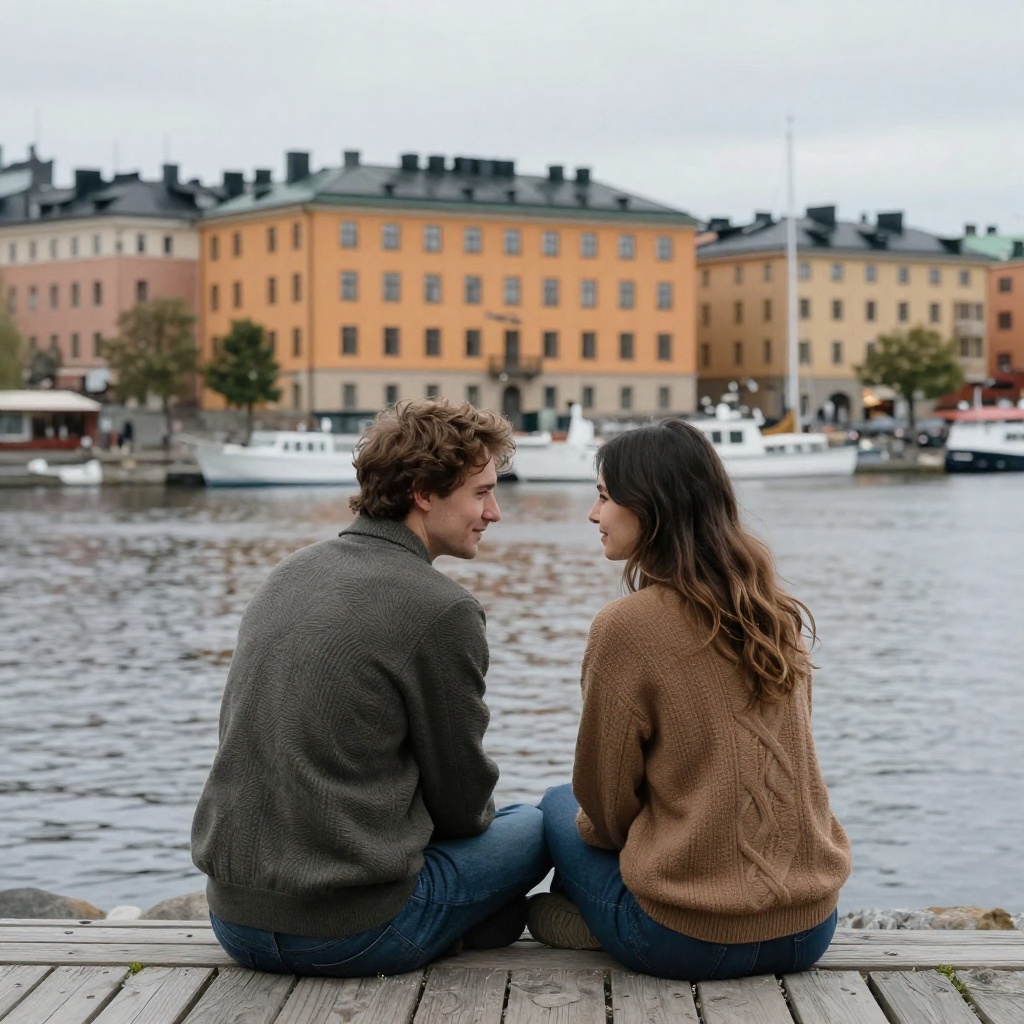
50 Swedish Compliments for Your Partner
Master 'Du är vacker' and 50+ Swedish compliments. Pronunciation guide included.
Swedes may have a reputation for being reserved, but when it comes to expressing love, they have a wonderfully warm vocabulary. Learning to compliment your Swedish partner in their native language will create a special connection.
The Most Beautiful Compliment
Phrase to Learn
Du är fantastisk
You are fantastic
[ doo air fan-TAS-tisk ]
A heartfelt compliment that Swedes love to hear. It conveys genuine admiration and appreciation.
In Swedish culture, sincere and understated compliments are valued over excessive flattery. When you compliment someone genuinely, it means the world to them.
Complimenting Appearance
Swedish compliments about appearance strike a balance between directness and subtlety. The word "vacker" (beautiful) carries more weight in Swedish than "beautiful" does in English—it's not used casually. When you call someone "vacker", you're making a meaningful statement about their beauty.
The concept of "naturlig skönhet" (natural beauty) is highly valued in Swedish culture. Compliments that acknowledge someone's natural features or effortless style are received more warmly than those that focus on artificial enhancement. This reflects broader Scandinavian values of authenticity and simplicity.
Pronunciation: na-TOOR-li
"Du har en naturlig skönhet."
Gender plays a role in compliment vocabulary. While "vacker" traditionally applies to women, modern Swedish increasingly uses it for anyone. "Snygg" (good-looking/hot) is more casual and gender-neutral, making it a safe choice when you're uncertain about formality.
For Women
Pronunciation: doo air VAK-er
"Du är så vacker idag!"
Pronunciation: doo air OON-der-bar
"Du är verkligen underbar!"
Pronunciation: doo air be-DOH-ran-de
"Ditt leende är bedårande."
Pronunciation: doo air STROH-lan-de
"Du är strålande ikväll!"
Pronunciation: doo air fan-TAS-tisk
"Du är helt fantastisk!"
For Men
Pronunciation: doo air snooyg
"Du är riktigt snygg!"
Pronunciation: doo air at-trak-TEEV
"Du är en attraktiv man."
Pronunciation: doo air stark
"Du är så stark!"
Pronunciation: doo air e-le-GANT
"Du ser elegant ut ikväll!"
Swedish Modesty
Swedes often follow "Jantelagen" - a cultural code promoting humility. Don't be surprised if your partner downplays compliments. Keep giving them anyway - they're deeply appreciated, even if the response seems modest!
Complimenting Specific Features
Complimenting specific physical features requires cultural awareness in Swedish. Eyes receive particular attention—"ögon" appears frequently in romantic compliments and poetry. The Swedish language has rich vocabulary for describing eye color and expression that English lacks.
When complimenting a smile, Swedish uses "leende" (smile) rather than the verb form. "Ditt leende lyser upp rummet" (Your smile lights up the room) is a common romantic expression that sounds natural rather than cheesy in Swedish. The key is specificity—describe what the smile does to you or the environment.
Voice compliments are particularly meaningful in Swedish culture, where tone and delivery matter enormously. "Du har en vacker röst" acknowledges an often-overlooked aspect of attraction. Voice is intimately connected to personality in Swedish perception.
Eyes
Pronunciation: doo har VAK-ra UH-gon
"Du har så vackra ögon!"
Pronunciation: yah DROON-knar ee DEE-na UH-gon
"Jag drunknar i dina ögon när jag ser på dig."
Pronunciation: DEE-na UH-gon LOO-ser som SHARE-nor
"Dina ögon lyser som stjärnor en mörk natt."
Smile
Pronunciation: doo har ett VAK-ert LE-en-de
"Ditt leende lyser upp rummet."
Pronunciation: doo air VAK-er nair doo lair
"Du är vacker när du ler, det värmer mitt hjärta."
Voice
Pronunciation: doo har en VAK-er rust
"Jag älskar att höra dig prata."
Personality Compliments
Personality compliments carry more weight than appearance compliments in Swedish relationships. "Snäll" (kind) is a foundational virtue in Swedish culture—calling someone "snäll" acknowledges their good character and compassion toward others. It's one of the highest compliments in Swedish society.
The distinction between "omtänksam" (thoughtful/caring) and "kärleksfull" (loving) is important. "Omtänksam" describes someone who considers others' needs and feelings proactively, while "kärleksfull" specifically relates to expressing love and affection. Both are deeply valued in Swedish partnerships.
Intelligence and capability are celebrated in Swedish culture without triggering jealousy. "Du ar duktig" (you're capable/competent) acknowledges someone's skills and achievements. It's commonly used between partners to recognize each other's accomplishments in work or daily life.
Pronunciation: fur-NOOF-ti
"Du är alltid så förnuftig."
Kindness and Character
Pronunciation: doo air snell
"Du är så snäll mot alla."
Pronunciation: doo air om-TENK-sam
"Du är en omtänksam partner."
Pronunciation: doo air SHARE-leks-full
"Du är så kärleksfull."
Pronunciation: doo har ett YAIR-ta av goold
"Du har verkligen ett hjärta av guld."
Intelligence and Talent
Pronunciation: doo air smart
"Du är så smart!"
Pronunciation: doo air be-GOH-vad
"Du är otroligt begåvad!"
Pronunciation: doo air ye-ni-AL
"Den idén är genial, precis som du!"
Humor and Fun
Pronunciation: doo air ROO-li
"Du är så rolig!"
Pronunciation: det air kool at VA-ra med dey
"Det är alltid kul med dig!"
Swedish Directness
Swedes value honesty and directness. A simple, genuine compliment often means more than elaborate praise. When you say something nice, your Swedish partner knows you truly mean it.
Romantic Compliments
Pronunciation: doo air min LOO-ka
"Du är all min lycka."
Pronunciation: doo yur mey LOOK-li
"Varje dag gör du mig lycklig."
Pronunciation: doo air det BES-ta som hent mey
"Jag är så glad att du finns, du är det bästa som hänt mig."
Pronunciation: yah air stolt UH-ver dey
"Jag är så stolt över dig!"
Pronunciation: med dey SHEN-er yah mey spe-si-ELL
"Med dig känner jag mig alltid speciell."
Complimenting Actions and Efforts
Pronunciation: doo LA-gar mat HIM-elskt
"Maten är himmelsk!"
Pronunciation: doo yur AL-ting per-FEKT
"Jag beundrar hur du gör allting perfekt."
Pronunciation: yah YIL-lar hoor doo yur det
"Jag gillar verkligen hur du gör det."
Poetic Comparisons
Pronunciation: doo air VAK-er som en roos
"Du är vacker som en ros i full blom."
Pronunciation: doo LOO-ser som SOO-len
"Du lyser som solen på en klarblå himmel."
Pronunciation: doo air som en ENG-el
"Du är min ängel!"
Fika and Compliments
Swedes bond over "fika" - coffee and pastry breaks. Sharing a fika with your partner is a perfect time for gentle compliments. The relaxed atmosphere makes heartfelt words feel natural.
Responding to Compliments
When your partner compliments you, here's how to respond:
| Swedish | Pronunciation | English |
|---|---|---|
| Tack | tak | Thank you |
| Du ocksa | doo OK-so | You too |
| Du smickrar mig | doo SMIK-rar mey | You flatter me |
| Verkligen? | VERK-li-gen | Really? |
| Du ar sa söt | doo air so sut | You're so sweet |
| Det ar snällt sagt | det air snellt sagt | That's nice to say |
Daily Compliments to Use
Make it a habit to compliment your partner daily:
| Situation | Swedish | English |
|---|---|---|
| Morning | Du ser bra ut | You look good |
| After cooking | Jattegott! | Very delicious! |
| Getting dressed | Det klär dig | It suits you |
| Working hard | Du ar duktig | You're good/capable |
| Being supportive | Tack för att du finns | Thanks for being you |
| Before bed | Jag har tur som har dig | I'm lucky to have you |
Quick Reference: Essential Compliments
Swedish compliment culture emphasizes authenticity over frequency. Rather than showering your partner with constant praise, Swedes prefer well-timed, meaningful compliments that reflect genuine observation. This approach stems from the cultural value of honesty—if you compliment something, you truly mean it.
Context matters significantly when choosing compliments. Morning compliments tend to be practical and encouraging, acknowledging appearance or readiness for the day. Evening compliments can be more reflective, appreciating efforts made throughout the day or expressing gratitude for shared time together.
Pronunciation: UP-skat-ning
"Jag vill visa min uppskattning."
The progression from casual to intimate compliments follows Swedish relationship development. Early in a relationship, "trevlig" (nice/pleasant) and "rolig" (fun) are safe choices. As intimacy grows, deeper terms like "älskad" (beloved) and "livskamrat" (life partner) become appropriate.
Pronunciation: ELSH-kad
"Min älskade partner."
For Her
| Swedish | English |
|---|---|
| Du ar vacker | You're beautiful |
| Du ar underbar | You're wonderful |
| Du ar bedårande | You're enchanting |
| Du ar smart | You're smart |
| Du ar snäll | You're kind |
For Him
| Swedish | English |
|---|---|
| Du ar snygg | You're handsome |
| Du ar stark | You're strong |
| Du ar manlig | You're manly |
| Du ar smart | You're smart |
| Du ar snäll | You're kind |
Universal
| Swedish | English |
|---|---|
| Du ar speciell | You're special |
| Jag ar stolt över dig | I'm proud of you |
| Du ar allt för mig | You're my everything |
| Det ar skönt med dig | It's good with you |
| Du ar bäst | You're the best |
Related Articles
Ready to learn together?
Speak their language, touch their heart. Fun games, voice practice & goals made for two.
Start Learning for $0.00 →✨ Try free — no credit card needed
Frequently Asked Questions
Besides physical appearance, what are some Swedish compliments to give about someone's skills or talents?
You can say 'Du är väldigt duktig på det här!' (You are very good at this!) or 'Du är så begåvad!' (You are so talented!). For a specific skill, you can say 'Du är jättebra på att sjunga!' (You are very good at singing!) or 'Du är en fantastisk kock!' (You are a fantastic cook!). These compliments show that you appreciate their abilities and efforts.
How can I compliment my partner's efforts or hard work in Swedish?
You can say 'Du har gjort ett fantastiskt jobb!' (You have done a fantastic job!) or 'Jag är så stolt över dig!' (I am so proud of you!). To acknowledge their effort, you can say 'Jag ser hur hårt du har jobbat' (I see how hard you have worked). These compliments show that you value their dedication and achievements. Remember to be specific about what you're complimenting.
What's a good way to respond when someone gives me a compliment in Swedish?
The most common way to respond to a compliment is to say 'Tack så mycket!' (Thank you very much!). You can also add 'Vad snällt sagt!' (How kind of you to say!). It's also polite to return the compliment if appropriate. For example, if someone compliments your cooking, you could say 'Tack! Jag är glad att du tycker om det' (Thank you! I'm glad you like it.).
Are there any cultural differences in how Swedes give and receive compliments?
Swedes tend to be more reserved with compliments than people in some other cultures. They value sincerity and avoid excessive flattery. When giving a compliment, be genuine and specific. When receiving a compliment, accept it graciously without downplaying your accomplishments. Modesty is appreciated, but not to the point of denying your talents.
How can couples practice giving and receiving compliments in Swedish to improve their communication and appreciation for each other?
Set aside time each day to give each other at least one sincere compliment in Swedish. Focus on both appearance and personality traits. You can also keep a gratitude journal and write down things you appreciate about each other. For example: A: "Du är så omtänksam." (You are so thoughtful.) B: "Tack! Det betyder mycket." (Thank you! That means a lot.).