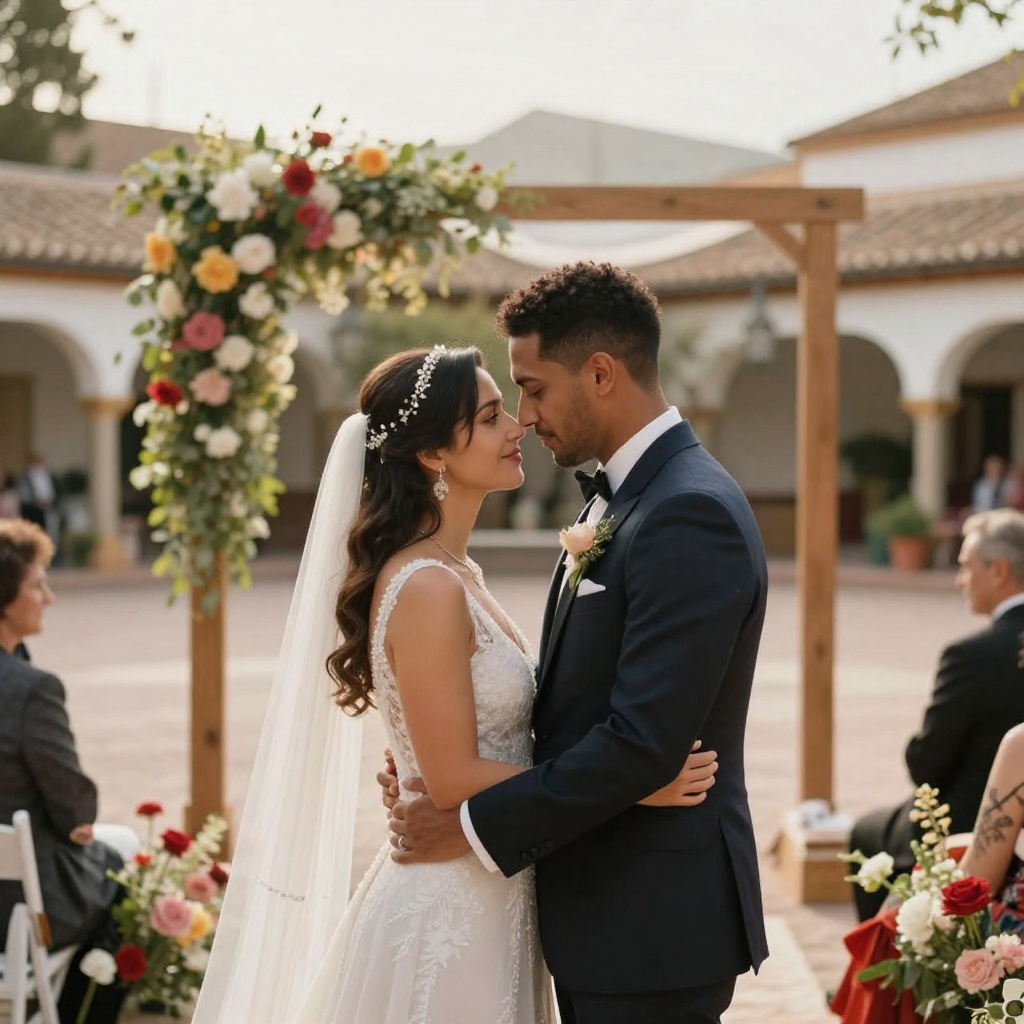
Spanish Honeymoon Travel Phrases for Couples
Spanish honeymoon phrases for couples: check in as newlyweds, ask for a double bed, toast at dinner and avoid the blunders English speakers make.
The one Spanish honeymoon phrase you will use again and again is Estamos de luna de miel (ehs-TAH-mohs deh LOO-nah deh MYEHL), "We're on our honeymoon." Add recién casados (rreh-SYEHN kah-SAH-dohs, "newlyweds"), una cama de matrimonio ("a double bed"), mesa para dos ("table for two") and ¡Por nosotros! ("To us!"), and you have most of a honeymoon covered. This guide groups the phrases you'll need from the airport to the last breakfast. Each one has an English-friendly pronunciation, and we point out the spots where Spanish trips English speakers up.
For more romantic expressions, see our guide to Spanish romantic phrases for every occasion.
Phrase to Learn
honeymoon
[ LOO-nah deh MYEHL ]
Literally 'moon of honey', the same image as the English word. It is feminine: la luna de miel, nuestra luna de miel.
How to read the pronunciations: capitals mark the stressed syllable. "rr" means a rolled r. The respellings use the Latin American "s" for c and z (habitación = ah-bee-tah-SYOHN). In most of Spain that sound is the "th" in think (ah-bee-tah-THYOHN). Both are correct.
Essential Honeymoon Vocabulary
| Spanish | Sounds like | English |
|---|---|---|
| la luna de miel | lah LOO-nah deh MYEHL | honeymoon |
| los recién casados | lohs rreh-SYEHN kah-SAH-dohs | newlyweds |
| el viaje | ehl BYAH-heh | trip |
| el destino | ehl dehs-TEE-noh | destination |
| la playa | lah PLAH-yah | beach |
| el pasaporte | ehl pah-sah-POHR-teh | passport |
| la maleta | lah mah-LEH-tah | suitcase |
| la reserva | lah rreh-SEHR-bah | booking (reservación in Mexico) |
| romántico / romántica | rroh-MAHN-tee-koh / -kah | romantic |
| el paraíso | ehl pah-rah-EE-soh | paradise |
| los recuerdos | lohs rreh-KWEHR-dohs | memories, and also souvenirs |
Three sounds matter most for English speakers here:
- v sounds like b. Viaje is BYAH-heh and vuelo (flight) is BWEH-loh. Spanish has no separate "v" sound with the teeth on the lip.
- h is silent, j is a breathy h. Habitación starts with a vowel: ah-bee-tah-SYOHN. The j in viaje is like the h in hello, only a bit raspier.
- An r at the start of a word is rolled. That's why romántico and recuerdos begin with "rr". A single r in the middle of a word, as in para, is a quick tap, like the tt in American "butter".
Pronunciation: rroh-MAHN-tee-koh
"¡Esto es tan romántico! (This is so romantic!)"
Planning Your Trip
Spanish-speaking honeymoon destinations include the beaches of Cancún, the vineyards of Mendoza, the volcanoes of Costa Rica and the streets of Barcelona. The core vocabulary is the same everywhere. A hotel room is una habitación in every country. Some words do change between countries, and we flag those as we go.
Choosing a Destination
- ¿Adónde vamos de luna de miel?: Where are we going on our honeymoon?
- Me encantaría un destino de playa.: I'd love a beach destination.
- Prefiero algo más tranquilo.: I'd prefer somewhere quieter.
- Busquemos el hotel perfecto.: Let's find the perfect hotel.
- ¡Esto parece un paraíso!: This looks like paradise!
Note the preposition in ir de luna de miel (to go on honeymoon). Spanish uses de where English uses "on". The same pattern gives you ir de viaje (to go on a trip) and ir de vacaciones (to go on holiday).
Pronunciation: pah-rah-EE-soh
"¡Este lugar es un paraíso! (This place is paradise!)"
At the Airport
Signs in big airports are usually in both Spanish and English. You'll need Spanish when something goes wrong, like a gate change, a missing bag or a missed connection. The person to ask is at the mostrador de información (information desk).
Learn to tell embarque (boarding, the noun) apart from embarcar (to board, the verb). The announcement Última llamada para el embarque del vuelo... means "Last call for boarding flight...". You want to recognise it instantly.
Essential Phrases
- ¿Dónde está la puerta de embarque? (DOHN-deh ehs-TAH lah PWEHR-tah deh ehm-BAHR-keh): Where is the boarding gate?
- ¿Tienes tu pasaporte?: Have you got your passport? (to your partner)
- Nuestra maleta no ha llegado.: Our suitcase hasn't arrived.
- Hemos perdido la conexión.: We've missed our connection. (In Latin America you'll often hear Perdimos la conexión.)
- ¡Empieza nuestra luna de miel!: Our honeymoon starts now!
Airport Vocabulary
| Spanish | English | Note |
|---|---|---|
| el vuelo | flight | BWEH-loh |
| la puerta (de embarque) | gate | literally "door" |
| la tarjeta de embarque | boarding pass | el pase de abordar in Mexico |
| el equipaje | luggage | uncountable, like English "luggage" |
| la maleta | suitcase | countable: dos maletas |
At Your Hotel
Check-in follows a predictable script, so it's one of the easiest conversations to prepare. You'll often hear the borrowed English words el check-in and el check-out at hotel desks.
The receptionist will speak to you with usted (the formal "you"). You don't have to match it perfectly, but polite forms like ¿Podría...? ("Could you...?") sound natural at the desk.
Checking In
- Tenemos una reserva a nombre de...: We have a booking under the name...
- Estamos de luna de miel.: We're on our honeymoon.
- Somos recién casados.: We're newlyweds.
- Queremos una cama de matrimonio, por favor.: We'd like a double bed, please.
- ¿Tienen habitaciones con vista al mar?: Do you have rooms with a sea view? (In Spain: con vistas al mar.)
- ¿A qué hora es el desayuno?: What time is breakfast?
- ¿Podríamos dejar la habitación un poco más tarde?: Could we check out a bit later?
- ¡Es precioso!: It's beautiful!
A 'double room' may have two beds
In Spanish hotels, una habitación doble is a room for two people, and that can mean two single beds. If you want one bed, ask for una cama de matrimonio (Spain) or una cama matrimonial (common in Latin America). In Spain, una habitación de matrimonio means a room with a double bed.
Room Types
| Spanish | English |
|---|---|
| la habitación doble | room for two (bed type varies) |
| la cama de matrimonio | double bed |
| las camas individuales | twin beds |
| la suite nupcial | bridal suite |
| con vista al mar / con vistas al mar | with a sea view |
Romantic Moments
On a beach at sunset, try Mira qué bonita es la puesta de sol ("Look how beautiful the sunset is"). Spanish exclamations follow a pattern English doesn't have: ¡Qué + noun + tan + adjective! So ¡Qué atardecer tan romántico! is "What a romantic sunset!" Once you know the frame, you can fill it with anything: ¡Qué playa tan bonita!, ¡Qué día tan perfecto!
On the Beach
- Esta playa es perfecta.: This beach is perfect.
- ¡Qué atardecer tan romántico!: What a romantic sunset!
- Te quiero. (teh KYEH-roh): I love you.
- Te amo. (teh AH-moh): I love you, said more intensely.
Te quiero is the everyday "I love you" between partners, and also for family and friends. Te amo is stronger and more solemn. It's heard more often between couples in Latin America than in Spain, where it can sound a little dramatic in daily speech. On a honeymoon, both fit.
At Dinner
| Moment | Spanish | English |
|---|---|---|
| Arrival | Mesa para dos, por favor. | A table for two, please. |
| Asking advice | ¿Qué nos recomienda? | What do you recommend (to us)? |
| Ordering to share | Para compartir. | To share. |
| Toast | ¡Salud! / ¡Por nosotros! | Cheers! / To us! |
| Toast | ¡Por nuestra luna de miel! | To our honeymoon! |
| Paying | La cuenta, por favor. | The bill, please. |
In ¡Salud! (sah-LOOD), the final d is very soft, almost like the th in this.
Late dinners, and the bill won't come by itself
In Spain, dinner usually starts around 9 p.m. or later, and a 7 p.m. booking can find the restaurant almost empty. Mealtimes in Latin America vary by country. In Spain and much of Latin America it's considered rude to bring the bill before you ask, so say La cuenta, por favor when you're ready to go.
Adventure Activities
Your guide will mostly use simple, concrete words, and in safety briefings understanding them matters more than speaking well.
Exploring Together
- ¡Vamos de aventura!: Let's go on an adventure!
- ¿Es seguro?: Is it safe?
- Me da un poco de miedo.: It scares me a little.
- ¡Cuidado!: Careful!
- Este viaje es increíble.: This trip is incredible.
Activity Vocabulary
| Spanish | English | Activity |
|---|---|---|
| el chaleco salvavidas | life jacket | boats, kayaking |
| el casco | helmet | zip-lining, cycling |
| el arnés | harness | zip-lining, climbing |
| bucear | to dive / to snorkel | water |
| hacer snorkel | to go snorkelling | water |
| explorar | to explore | anywhere |
Creating Memories
To ask a stranger to take your photo, use the polite form: ¿Nos podría tomar una foto, por favor? ("Could you take a photo of us, please?"). In Spain people more often say hacer una foto instead of tomar una foto. The person with your phone may say Sonrían ("Smile", to both of you), Un poco más a la izquierda ("A bit more to the left") or ¿Una más? ("One more?").
Watch the word recuerdos. It means "memories", but also "souvenirs", so una tienda de recuerdos is a souvenir shop.
Photo Moment Phrases
- ¿Nos podría tomar una foto?: Could you take our photo? (to a stranger)
- ¡Tómanos una foto!: Take a photo of us! (only to a friend; this is the informal tú command)
- Nuestra luna de miel en Oaxaca: Our honeymoon in Oaxaca (a caption)
- ¡El mejor viaje de nuestra vida!: The best trip of our lives!
Pronunciation: rreh-KWEHR-dohs
"Estamos creando recuerdos preciosos. (We're making beautiful memories.)"
Returning Home
You pack with hacer las maletas in Spain or empacar in much of Latin America. For the last breakfast, it's la cuenta, por favor one more time.
The nicest goodbye to the hotel staff is Volveremos (bohl-beh-REH-mohs), "We'll come back." Spanish puts the future into one verb, so there's no separate word for "will". In conversation people also often say Vamos a volver, which means the same.
End of Trip
- ¡Qué luna de miel tan increíble!: What an incredible honeymoon!
- ¡No quiero irme!: I don't want to leave!
- Gracias por todo.: Thank you for everything. (to the staff)
- Gracias por este viaje.: Thank you for this trip. (to your partner)
- Volveremos.: We'll be back.
For outings closer to home, see our Spanish date night planning vocabulary guide.
A Honeymoon Conversation
On the hotel terrace, planning tomorrow (Spain):
Partner: ¿Qué quieres hacer mañana?
What do you want to do tomorrow?You: Me encantaría ir a la playa por la mañana y cenar en el restaurante del puerto.
I'd love to go to the beach in the morning and have dinner at the restaurant by the harbour.Partner: Vale. ¿Reservo mesa para las nueve y media?
OK. Shall I book a table for half past nine?You: ¿Tan tarde? Bueno, ¡estoy muy emocionado!
That late? Well, I'm so excited!Partner: Yo también, cariño. ¡Por nuestra luna de miel!
Me too, love. To our honeymoon!
Vale ("OK") is very Spanish from Spain. In Mexico you'd more likely hear Va or Órale, and in much of Latin America simply Bueno or Dale. A woman says emocionada.
Mistakes English Speakers Make
- "Estoy excitado." Excitado usually means sexually aroused. For "I'm excited", say Estoy muy emocionado/a, or in Spain Tengo muchas ganas ("I'm really looking forward to it").
- "Estoy embarazada" for "I'm embarrassed." This means "I'm pregnant." Say Qué vergüenza or Me da vergüenza.
- "Me casé a ella." In Spanish you marry with someone: Me casé con ella, Nos casamos el sábado.
- Using tú commands with strangers. Tómanos una foto is fine with your partner. With a stranger or the hotel staff, use ¿Nos podría...?
- Asking for una habitación doble and expecting one bed. Ask for una cama de matrimonio.
- Pronouncing v and h the English way. Vista is BEES-tah, and habitación has no h sound.
5-Minute Practice
Role-play check-in. The native-speaking partner is the receptionist and uses usted. The learner has to say, in order:
- Tenemos una reserva a nombre de...
- Estamos de luna de miel.
- Queremos una cama de matrimonio, por favor.
- ¿A qué hora es el desayuno?
The receptionist throws in one complication, such as Solo nos quedan camas individuales ("We only have twin beds left"), and the learner has to react in Spanish. Swap roles, then do the same at a restaurant: table for two, a recommendation, a toast and the bill.
Quick Reference Card
| Need | Spanish |
|---|---|
| Say you're on honeymoon | Estamos de luna de miel. / Somos recién casados. |
| Get the right bed | Una cama de matrimonio, por favor. |
| Find your gate | ¿Dónde está la puerta de embarque? |
| Eat together | Mesa para dos. / ¿Qué nos recomienda? |
| Celebrate | ¡Salud! / ¡Por nosotros! |
| Get a photo | ¿Nos podría tomar una foto? |
| Pay and leave | La cuenta, por favor. / Volveremos. |
Practise It Together
Tonight, plan one day of your honeymoon out loud, entirely in Spanish, using Me encantaría..., ¿Qué quieres hacer? and one ¡Qué... tan...! exclamation. The native-speaking partner corrects only pronunciation of v, h and r.
Love in more than one language? Love Languages helps couples grow closer through each other's language, with fun games, conversation coaching and 114 languages for every kind of international romance.
Love Languages
Start learning together
Practice with your partner, celebrate progress together, and turn today's lesson into something you share.
Start together7 days free · Cancel anytime
Frequently Asked Questions
Is 'luna de miel' masculine or feminine, and how do you say 'go on honeymoon'?
It is feminine because of 'luna': la luna de miel, nuestra luna de miel. The plural is 'lunas de miel'. 'To go on honeymoon' is 'irse de luna de miel' or 'ir de luna de miel', for example: '¿Adónde os fuisteis de luna de miel?' (Spain) or '¿Adónde se fueron de luna de miel?' (Latin America).
How do I say 'we just got married' in Spanish?
Use 'acabar de' plus an infinitive: 'Nos acabamos de casar' or 'Acabamos de casarnos' (We've just got married). To give the date, say 'Nos casamos el sábado pasado' (We got married last Saturday). Don't translate 'just' as 'justo': 'Nos casamos justo' sounds odd.
What do I call my husband or wife in Spanish?
'Mi esposo' and 'mi esposa' work everywhere. In Spain, 'mi marido' and 'mi mujer' are very common and completely normal. 'Mi pareja' (my partner) is neutral and works for any couple. Common pet names include 'cariño', 'mi amor' and 'cielo'; 'gordo/gorda' is affectionate in many countries, but it's best to let your partner use it first.
Do I need different Spanish for a honeymoon in Mexico versus Spain?
The core is the same, but a few words change. Spain uses 'vosotros' for 'you all', while Latin America uses 'ustedes'. Spain says 'zumo', 'coche' and 'hacer una foto'; Mexico says 'jugo', 'carro' and 'tomar una foto'. Avoid 'coger' for 'to take' in Mexico and Argentina, where it is vulgar; use 'tomar' instead ('tomar el autobús').