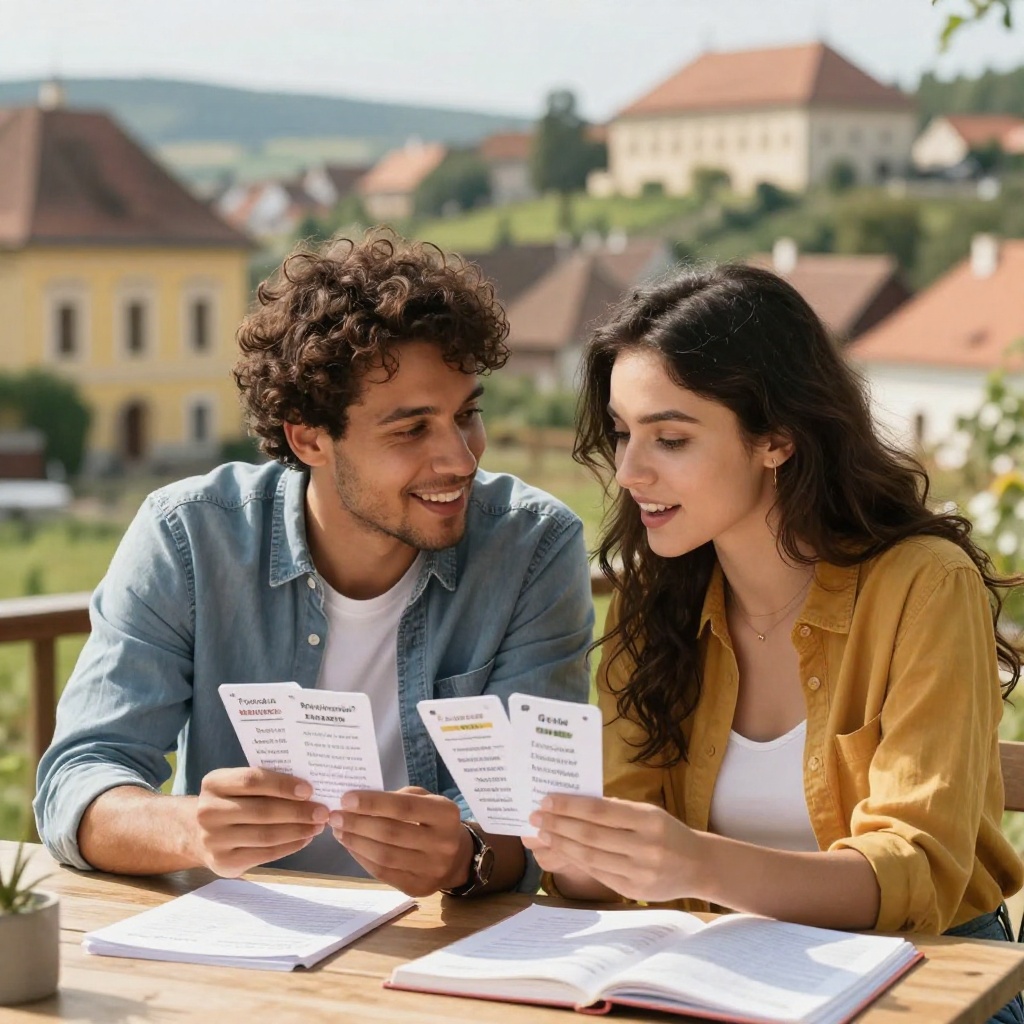
Expressing Emotions in Romanian: Feelings Vocabulary for Couples
Learn to express your feelings in Romanian. Essential emotional vocabulary for couples to communicate happiness, love, and everything.
Being able to name your feelings in Romanian makes emotional conversations feel more direct and more personal. The language has a strong set of everyday emotion words, and many of them work naturally in couple conversations.
Phrase to Learn
Te iubesc
I love you
[ teh yoo-BESK ]
Strong, direct, and appropriate for a romantic partner
Essential Phrases
These phrases are essential for expressing emotions with your Romanian-speaking partner:
| Romanian | English | Pronunciation |
|---|---|---|
| Te iubesc | I love you | teh yoo-BESK |
| Țin la tine | I care about you | tsin lah TEE-neh |
| Îmi e dor de tine | I miss you | eem eeeh dor de TEE-neh |
| Mă simt fericit/ă | I feel happy | muh seemt feh-ree-CHEET |
| Mă simt trist/ă | I feel sad | muh seemt treest |
Te iubesc (teh yoo-BESK) is the most important phrase to know, but it is not the only useful one. Țin la tine is softer than Te iubesc and works well when you want to show care without sounding overly intense.
Cultural Tip
In Romanian, emotional language sounds most natural when it is specific. Saying exactly how you feel, or why, usually lands better than using only broad statements. In close relationships, informal tu forms are normal.
More Useful Expressions
| Romanian | English | Pronunciation |
|---|---|---|
| Mă simt fericit/ă | I feel happy | muh seemt feh-ree-CHEET |
| Mă simt liniștit/ă | I feel calm | muh seemt lee-NEESH-teet |
| Îmi este dor de tine | I miss you | eem ee-steh dor de TEE-neh |
| Mă simt trist/ă | I feel sad | muh seemt treest |
| Sunt îngrijorat/ă | I'm worried | soont oon-gree-zhoh-RAHT |
| Sunt entuziasmat/ă | I'm excited | soont en-too-zee-ahs-MAHT |
| Mă simt vulnerabil/ă | I feel vulnerable | muh seemt vool-neh-rah-BEEL |
| Mă simt recunoscător / recunoscătoare | I feel grateful | muh seemt reh-koo-nohs-kuh-TOHR / reh-koo-nohs-kuh-TOH-ah-reh |
Pronunciation: eem ee-steh dor de TEE-neh
"Îmi este dor de tine în fiecare zi."
Additional Phrases
| Romanian | English | Pronunciation |
|---|---|---|
| Sunt obosit/ă | I’m tired | soont oh-boh-SEET |
| Sunt copleșit/ă | I’m overwhelmed | soont koh-pleh-SHEET |
| Sunt nervos/oasă | I’m nervous / upset | soont ner-VOHS / ner-VOH-ah-suh |
| Sunt recunoscător / recunoscătoare | I’m grateful | soont reh-koo-nohs-kuh-TOHR / reh-koo-nohs-kuh-TOH-ah-reh |
| Mă simt rănit/ă | I feel hurt | muh seemt ruh-NEET |
| Mă simt în siguranță cu tine | I feel safe with you | muh seemt een see-goo-RAHN-tsuh koo TEE-neh |
Tips for Using These Phrases
- Use body language - A calm tone matters as much as the words.
- Be specific - Romanian emotional phrases sound stronger when you explain the reason.
- Choose the right intensity - Țin la tine is softer than Te iubesc, and Mă simt rănit/ă is more direct than just Sunt trist/ă.
- Keep it conversational - In close relationships, informal tu forms feel natural.
Practice Makes Perfect
Learning to express emotions in your partner's language shows care, but the phrasing matters. Romanian couples often sound most natural when they mix a clear feeling word with a short explanation, like Îmi este dor de tine or Mă simt în siguranță cu tine.
Related Articles
- Essential Romanian Phrases for Couples
- How to Say I Love You in Romanian
- Romanian Pet Names and Terms of Endearment
Delving Deeper: Nuances and Context
Romanian makes a useful distinction between direct emotion statements and softer relational language. Te iubesc is unmistakably romantic, while Țin la tine communicates care, closeness, and commitment without sounding quite as intense. Both are useful, but they are not interchangeable.
For milder feelings, Romanian often uses mă simt plus an adjective: Mă simt trist/ă, Mă simt calm/ă, or Mă simt vulnerabil/ă. That pattern is more natural for “I feel…” than the older-style, word-for-word English translation.
When you want to soften something, add a limiter like puțin or cam. For example, Mă simt puțin trist/ă means “I feel a little sad,” and Sunt cam nervos/oasă means “I’m a bit nervous / upset.”
Pronunciation: muh seemt poo-TEEN treest
"Mă simt puțin trist/ă azi, dar o să-mi treacă."
It is also helpful to combine emotion with a relational phrase. Am nevoie de tine can sound very intense, so in many conversations Îmi este dor de tine, Mă simt în siguranță cu tine, or Am nevoie de puțin timp feel more precise and natural.
Pronunciation: Ahm neh-VOY-eh deh TEE-neh
"Am nevoie de tine acum, te rog, vino aici."
For an even softer version, say Mi-e dor de tine or Aș vrea să fii aici depending on what you want to communicate. Those forms are especially useful when you want to sound tender rather than dramatic.
Pronunciation: Simt kuh Ahm neh-VOY-eh deh TEE-neh
"Simt că am nevoie de tine lângă mine."
Related Articles
Ready to learn together?
Speak their language, touch their heart. Fun games, voice practice & goals made for two.
Start Learning for $0.00 →✨ Try free — no credit card needed
Frequently Asked Questions
How do I say 'I'm proud of you' in Romanian?
You can say 'Sunt mândru/mândră de tine' (I am proud of you). The masculine form is 'mândru' and the feminine form is 'mândră'. Use the appropriate form depending on your gender. Showing pride in your partner's accomplishments strengthens your bond.
What's a good way to express gratitude in Romanian?
The most common way to express gratitude is 'Mulțumesc' (Thank you). You can add 'foarte mult' (very much) to emphasize your gratitude: 'Mulțumesc foarte mult'. You can also say 'Îți sunt recunoscător/recunoscătoare' (I am grateful to you). Remember to use the correct gender form.
How can I tell my partner that they make me happy in Romanian?
You can say 'Mă faci fericit/fericită' (You make me happy). Again, use the masculine 'fericit' or feminine 'fericită' form. You could also say 'Îmi aduci bucurie' (You bring me joy). Expressing your happiness is essential for a positive relationship.
How do I express sympathy in Romanian?
You can say 'Îmi pare rău' (I'm sorry) when someone is going through a difficult time. You can also say 'Sunt alături de tine' (I'm here for you) to offer support. Showing empathy is crucial for comforting your partner.
How can couples practice expressing emotions in Romanian together?
Take turns describing a situation that evokes a particular emotion, and then practice expressing that emotion in Romanian. For example, one partner can describe a stressful day at work, and the other can practice offering comfort. Role-playing will help you become more comfortable expressing your feelings authentically. Try saying 'Te înțeleg' (I understand you).